
编制机构:雅昌艺术市场监测中心(AMMA)
编制机构:雅昌艺术市场监测中心(AMMA)





“山花迷人眼”中国台湾水墨艺术家彭康隆个展于2025年11月14日至2026年3月8日在广东美术馆白鹅潭馆区展出,全面梳理其独创融合山水与花卉两种题材的当代演绎。展览由广东美术馆主办,墨斋协办,广东美术馆馆长王绍强任总策划,中国美术馆研究馆员邓锋担纲策展。展出近90幅珍品,时代跨度25年,其中多件超长手卷、巨幅画作与特制屏风等均系首次在中国大陆亮相。并于11月21日展览开幕当日举办了此次展览的研讨会。
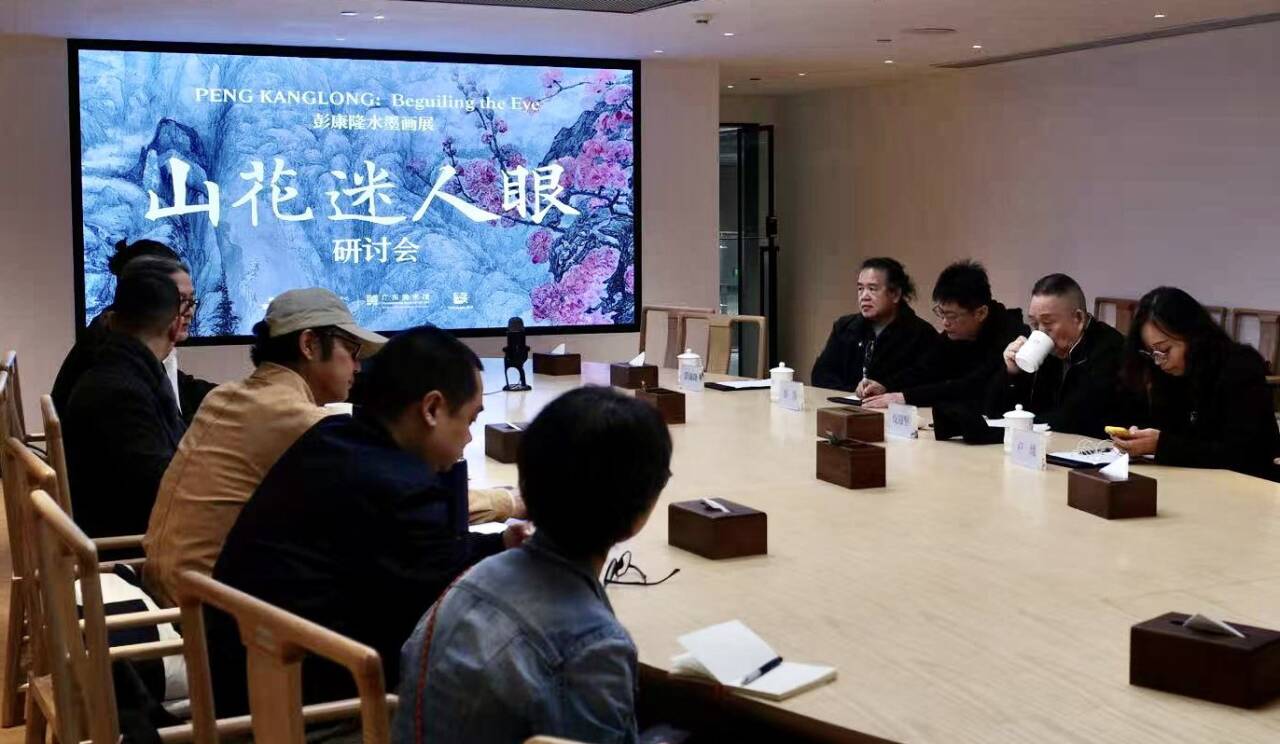
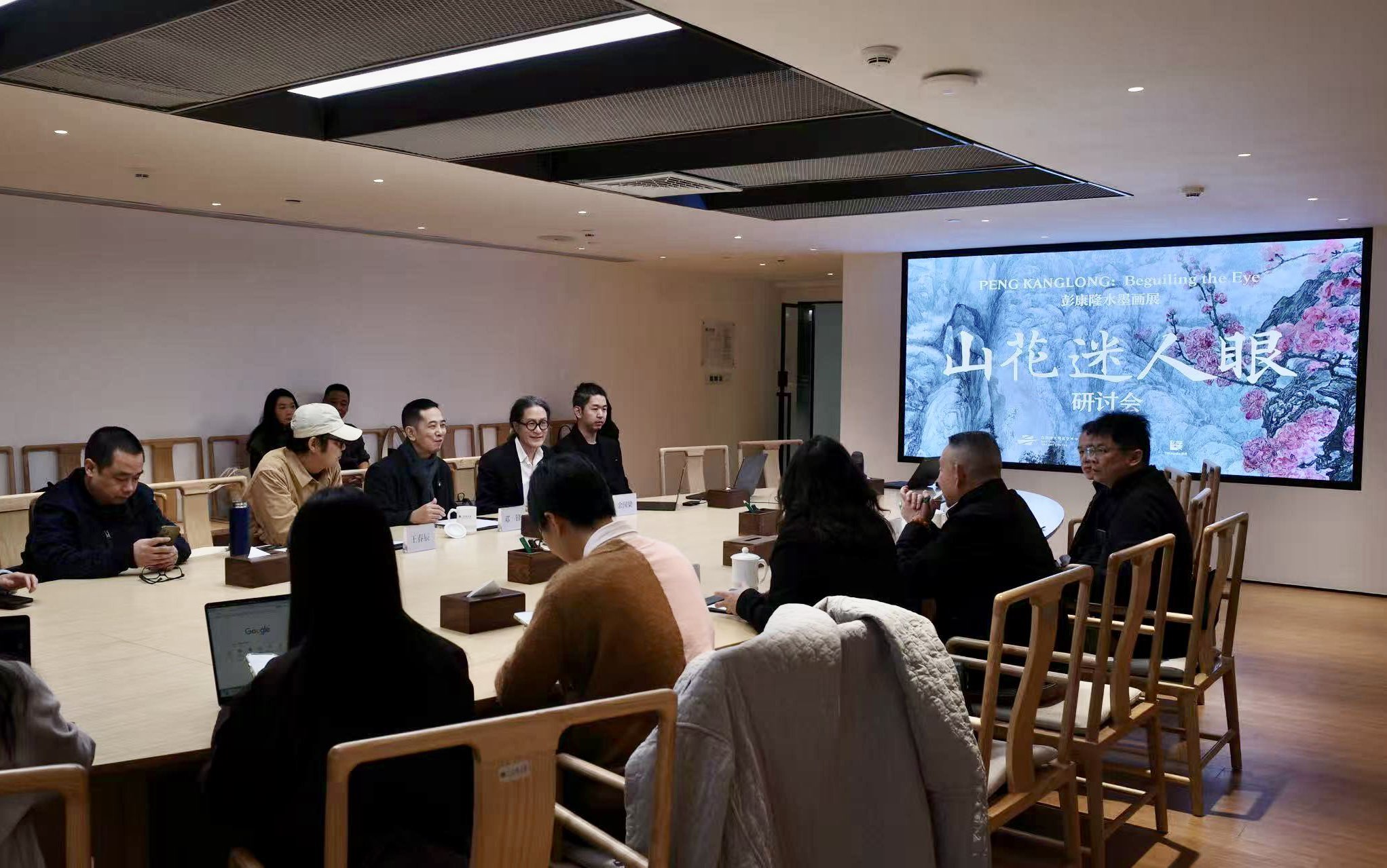
研讨会现场
《山花迷人眼:彭康隆水墨画展》研讨会
主持人:策展人、中国美术馆研究馆员 邓锋
研讨会嘉宾:
著名批评家、华南师范大学美术系教授 皮道坚
广州美术学院人文学院的教授 蔡涛
深圳两馆的副馆长、著名策展人 卢缓
中央美术学院教授 王春辰
雅昌艺术网主编 裴刚
墨斋的创始人 余国梁
中国台湾水墨艺术家 彭康隆
地点:广州市荔湾区白鹅潭南路19号,广东美术馆白鹅潭馆区会议室
时间:2025年11月21日(周五)
研讨会实录:
邓锋:
各位师友前辈、各位嘉宾,特别高兴大家在这么好的时节齐聚在广州。我是彭康隆老师展览《山花迷人眼》的策展人邓峰,欢迎大家。我们就开始我们今天上午的小型研讨和座谈。
Distinguished mentors, friends, seniors, and esteemed guests, it brings me great joy to see everyone gathered here in Guangzhou during such a wonderful season. I am Deng Feng, the curator of Peng Kanglong’s exhibition Beguiling the Eye. Welcome, everyone. Let us now begin this morning’s seminar and discussion.
我们今天人也不多,都是几位,尤其有皮老师在,还有我们老中青的几代,我觉得大家在一块聊一聊,是一个特别愉快的事情。还有媒体的几位朋友。
那我还是先简单介绍一下今天的几位专家。首先皮道坚老师,这个不用多说,是我们的前辈;我们基本上大家从事这一块研究的,都读过皮老师的著作。谢谢皮老师。
There aren’t many of us here today—all are professionals from this field. We are especially honored to have Professor Pi Daojian here today, as well as representatives from multiple generations. I believe it will be a particularly pleasant experience for us to talk about Peng Kanglong’s art together. We also have a few friends from the media joining us today.
Let me briefly introduce the experts who is participating in our discussion today. First, let’s welcome Professor Pi Daojian, who, needless to say, is our respected senior. Most of us working in this field have read his works. Thank you, Professor Pi.
旁边蔡涛先生,广州美术学院人文学院的教授,做近代美术史研究做得非常好,也是我们的学长。卢缓,深圳两馆的副馆长、著名策展人。这边王春辰先生,中央美术学院的教授,我们也欢迎。
Next is Professor Cai Tao from the School of Humanities at the Guangzhou Academy of Fine Arts, who excels in the study of modern art history and is also our senior alumnus. Professor Lu Huan, deputy director of the Shenzhen Museum of Contemporary Art and Urban Planning and a renowned curator. And over here is Professor Wang Chunchen from the Central Academy of Fine Arts. Welcome.
裴刚,是雅昌艺术网的主编,欢迎。余国梁先生,墨斋的创始人,在他和王少强馆长的联合推动下,促成了这样一个展览,欢迎。最后隆重推出我们这次展览的主角——彭康隆老师。
那这个展览呢,我先简单介绍一下情况,然后特别想聆听各位师友前辈的高见。
Mr. Pei Gang is the editor-in-chief of Artron Art Network—welcome. Mr. Craig Yee, founder of INKstudio, played a key role in realizing this exhibition through his collaboration with Museum Director Wang Shaoqiang. Welcome. And finally, let me proudly introduce the star of today’s exhibition—artist Peng Kanglong.
Now, I’ll begin by briefly introducing the background of this exhibition, after which I am especially looking forward to hearing the insights and perspectives from all our mentors, friends, and seniors.
我大概是 2023 年在墨斋看到彭老师的一个展览,当时也是受余先生邀请去看。我那时候不认识彭老师,所以到现场看了展览之后,我觉得作品非常有意思。首先是作品本身就很吸引我。
It was around 2023 when I saw Peng Kanglong’s solo exhibition at INKstudio, Beijing. I was invited by Craig at that time. I didn’t know Mr. Peng then, so after seeing the exhibition in person, I found the artworks very interesting—the pieces themselves were highly appealing to me in the first place.
然后就跟彭老师聊。聊的时候,我们就……因为我自身是做传统出身,所以我一看彭老师的作品,我就感觉跟传统有很多关联性,尤其是跟晚明的变形主义风格,跟吴彬的这种变形主义风格,和董其昌以来的笔墨自律,我觉得都有关系,包括他也吸收龚贤很多东西。
I then had a conversation with Mr. Peng. When we talked... because I come from a traditional background myself, as soon as I saw his work, I felt a strong connection to tradition. In particular, I saw ties to the Mannerist style of the late Ming dynasty—the kind of Distortionism found in artists like Wu Bin—as well as to the self-discipline of brush and ink that began with Dong Qichang. I think his work also absorbs many elements from Gong Xian.
然后一聊,彭老师就给我推荐了一本专门写晚明的书,叫《堕落时代》。我回去还专门去看了。所以那次聊得就很愉快。我们都在考虑中国画,或者说今天讲的水墨,如何更具有一种当代的个人特质。我觉得彭老师在这方面做了很多探索。
During our conversation, Mr. Peng recommended a book to me—a specialized work on the late Ming dynasty titled The Age of Decline. I made sure to read it after returning home. So that conversation was very enjoyable. We both discussed how Chinese painting, or what is referred to today as ink art, can develop a more contemporary and individual quality. I think Mr. Peng has done a lot of exploration in this area.
所以去年 2024 年的时候,应彭老师之约,我去他台北的工作室看了很多原作。看完原作之后,我们就从去年开始在酝酿这样一个展览。在广东馆王少强馆长的积极推动下,有了今天这样的展览。
So last year, in 2024, at Mr. Peng’s invitation, I visited his studio in Taipei and saw many of his original works. After viewing them, we began planning for this exhibition, which has now taken shape today through the active support of Director Wang Shaoqiang of the Guangdong Museum of Art.
这个展览呢,我给它取名叫“山花迷人眼”。“山花迷人眼”当然很直接,大家一看就很明白,就是山花,山与花的组合交错,交错当中有一种迷乱的感觉。而这种迷乱的感觉,当它转化为密密麻麻的墨线和皴的结合,成为一种笔墨语言的时候,给人又是一种逼人的视觉感。
This exhibition is titled “Beguiling the Eye”, which is quite direct—everyone can immediately realize that it is the combination and interweaving of mountains and flowers that create a sense of bewilderment through their interplay. When this beguiling visual experience transforms into a language of brush and ink, characterized by dense, intricate brushwork and texture strokes, it delivers yet another kind of striking visual impact.
我觉得在山花和人眼之间形成的一种关系,中间是“迷”字,以“迷”作为一个连接。但其实,山与花的这种结合,在彭老师作品里大概是 2012 年前后就已经开始看到。这种结合在传统中国画里很少见,山水画我们更多的是讲意境;而花鸟画更多的讲生意——生命力的表达。这两者一结合,20世纪有潘天寿前辈做过这样的尝试;像黄宾虹是山水和花卉是分开的,分道而行的。但彭老师把它们组合在一块,我觉得特别有意思。
I believe the relationship between the mountain flowers and the human eye is mediated and connected by the character “迷” (mi, beguile). However, the combination of mountains and flowers began to emerge in Peng’s work around 2012. Such a combination is uncommon in traditional Chinese painting. In landscape painting, we often emphasize the poetic conception, while bird-and-flower painting focuses more on vitality and the expression of life force. In the 20th century, predecessors like Pan Tianshou attempted to combine these two genres, while Huang Binhong kept landscapes and flower subjects distinctly separate. Yet, Peng Kanglong’s integration of the two is particularly fascinating.
其实从我们的视觉经验来看,我们到户外去看,会觉得所有的花花草草、花鸟山石,它们都在一个大的山水环境当中。他把这种东西还原到一个山水的大的生态背景当中的时候,这些花草和山水之间就形成了非常有意思的一种纠结感。而且每一种花草,我觉得都有自己的独立性格,哪怕是一根小草。我觉得它与庞大的山水自然形成了一种特别有意思的关系。所以我觉得这是彭老师作品非常有意思的地方,让传统母题富有了新意。而且这种新意,是带着非常强烈的个人情绪感的。我觉得彭老师作品里,有非常强烈的个人情绪感。
In fact, from our visual experience, when we venture outdoors, we feel that all the flowers, plants, birds, and rocks exist within a grand landscape environment. By placing these elements back into a broader ecological context of landscape, an intriguing sense of entanglement emerges between the flower and the landscape. Moreover, I believe every plant, even a single blade of grass, possesses its own distinct character. It forms a particularly fascinating relationship with the vastness of natural landscapes. This, I think, is what makes his work so compelling—it revitalizes traditional motifs with fresh meaning. And this freshness carries a powerful sense of personal emotion. I can feel the strong personal emotions in Peng’s works.
那么在笔墨语言的组织当中,我个人又觉得彭老师的笔墨并不是传统笔墨。因为传统笔墨,大家都觉得是一种理想人格的追求,它有很多笔墨的要求,比如讲筋骨血肉、讲顿挫,它其实是对理想人格的要求。但彭老师这个,我觉得他已经不是对于理想人格的要求,而是把人性、自我的内在的情绪状态,用笔线的方式——而不是传统笔墨的要求——把它铺展开、弥漫开,让它们相互产生关系。
In the organization of brushwork language, I personally feel that Peng Kanglong’s approach is not traditional. Traditional brush and ink is often seen as a pursuit of an idealized personality, with many technical requirements—such as emphasizing the bone, the tendon, the flesh, and the blood in the strokes, or the rhythm of pauses and turns—which essentially reflect demands for an ideal personality. However, Peng’s brushwork, I believe, no longer strives for this idealized character. Instead, he unfolds and diffuses human nature and inner emotional states through brushwork—not in the manner of traditional brush and ink requirements—allowing these elements to interact and relate to one another.
但是在笔墨背后,我觉得彭老师非常厉害的一点就在于他特别懂得笔墨之道。笔墨之道是什么?我个人感觉,彭老师对于阴阳、虚实、有无的这种生发关系,在他作品当中转化和利用得太好了。处处讲阴阳,处处讲虚实、有无转化,所以他的笔墨是能呼吸的。就此而言,这个笔墨又与传统高度吻合。
However, beneath the brushwork, what I find particularly remarkable about Mr. Peng is his profound understanding of the essence, or Dao, of brush and ink. What is this Dao? In my view, Mr. Peng masterfully transforms and employs the generative relationships between yin and yang, void and substance, presence and absence in his work. Every part of his painting speaks of the interplay between yin and yang, void and substance, and the transformation of presence and absence. As a result, his brushwork seems to breathe with life. In this sense, his approach to brush and ink resonates deeply with tradition.
除了阴阳之外,我觉得就是“生生”,生生不息的“生生”,不断地生发,随机生发。所以他的笔墨既跟脱离传统,但在内在的精神气质上,又与传统暗合。我个人觉得是有这样一种感觉。
Besides the concept of yin and yang, I also see the principle of “generation” — the continuous, spontaneous, and ever-renewing vitality that permeates his work. Thus, while his brushwork diverges from tradition in form, it aligns with tradition in its deeper spiritual essence. This is my personal impression on his brushwork.
这前面是我大概对彭老师的一点理解,也算是抛砖引玉。接下来特别想听到诸位的高见。我们首先有请皮老师。皮老师关注中国当代水墨这么多年,对于实验水墨的支持。而且皮老师也提到,他最新讲的是水墨的精神,是水墨背后的东西,而且讲水墨跟自身文化的关系,而不仅仅是水墨画或水墨艺术的问题,我觉得这点特别重要。
谢谢,有请皮老师。
These are just some of my initial thoughts on Mr. Peng’s work, intended to spark further discussion. Now, I would like to hear the insightful views from the distinguished guests. First, let’s invite Professor Pi Daojian, who has been focusing on the field of contemporary Chinese ink art for many years and has been a strong supporter of experimental ink practices. Professor Pi has also emphasized—particularly in his recent discussions—the spirit of ink, what lies behind it, and its relationship to our own culture. This goes beyond mere ink painting or ink art as a form, and I find this perspective especially important. Let’s now welcom Professor Pi.
皮道坚:
谢谢邓老师。很高兴、也很荣幸,今天来参加彭老师的个展和研讨会。
Thank you, Professor Deng. I am very happy and honored to be here today to attend Peng Kanglong’s solo exhibition and seminar.
我是上个世纪的 90 年代,那时候广州有一个“走向 21 世纪的水墨艺术研讨会”。在那个会上我就提出来了,我说我们的现当代水墨艺术,应该是我们的当代艺术的一个非常重要的组成部分。这个观点当时有很多辩论,他们可能知道一些。
Back in the 1990s, during a symposium in Guangzhou titled “Ink Art Marching Toward the 21st Century,” I put forward the idea that our modern and contemporary ink art should be a crucial part of our contemporary art. This viewpoint sparked quite a bit of debate at the time, and some of you might still remember it.
后来我的观点一直发展。2013 年,香港艺术馆请我做了一个《原道:中国艺术新概念》,那时候我也强调了这样一个观点。到了 2016 年,红专厂当代艺术馆请我做了一个《天下往来》,就是讲新世纪16年以来的当代水墨发展的这样一个轨迹或者是线索,这样一个展览,就坚定了我的这样一种看法。
Later, my perspective continued to develop. In 2013, the Hong Kong Museum of Art invited me to curate an exhibition called “Tracing the Origin: A New Concept in Chinese Art,” where I emphasized this idea once again. Then in 2016, the Redtory Museum of Contemporary Art invited me to organize “The World, Coming and Going,” an exhibition that traced the trajectory and development of contemporary ink art over the past 16 years since the new century. This exhibition further strengthened my belief in this viewpoint.
我认为水墨艺术,是我们中华文化的一条长河,不断的生命线,它是我们民族文化身份的一个重要的资源。还有,它是我们的中华文化、我们的水墨艺术,往返古今中外的一个精神之洲。我当时在那个红专厂那个前言里面,我就提出来了这样一点。
Ink art is a long, continuous river in Chinese culture—a lifeline that never breaks. It is a vital resource for our national cultural identity. Moreover, it serves as a spiritual island where Chinese culture and our ink art journey back and forth between ancient and modern times, China and the rest of the world. I raised this point in the preface I wrote for the exhibition at the Redtory Museum.
这次展览呢,很早张义就把彭先生的作品发给我看了,包括策展人你刚才讲的那些论述。画册前两天我收到了,我也认真地看了,今天早上刚刚又看了这个展览,更加坚定了我这样一个信念或者看法。
In terms of this current exhibition, Zhang Yi has shared Mr. Peng’s works with me quite early on, including the statements the curator just mentioned. I received the exhibition catalog a few days ago and studied it carefully. Then, having just viewed the exhibition in person this morning, it has only strengthened my belief and perspective even further.
我认为彭先生的“水墨山花世界”吧——《山花迷人眼》——我认为他的水墨艺术、他的水墨山花世界,是我们当代水墨的一个别开生面的案例,一个典型的案例。这个我想,不光只是从水墨的形式语言层面的探索,你刚才讲了很多,我们都谈到的是水墨语言在形式层面上的探索;还是观念和精神方面的追求,这两个方面,我认为彭先生是深谙我们古典艺术的传统,但是呢,他又并不恪守古法,而是把我们完满、纯粹的传统艺术语言,把它推入到当代文化语境之中。
I think Peng Kanglong’s ink art and his “Ink World of Mountain Flowers ”—or Beguiling the Eye, as the title of the this exhibition suggests—represents a refreshing and exemplary case in contemporary ink art. In my view, his work goes beyond merely exploring the formal language of ink, as we have extensively discussed. It also embodies a pursuit of conceptual and spiritual aspects. Mr. Peng demonstrates a profound understanding of Chinese classical art traditions, yet he does not rigidly adhere to ancient methods. Instead, he elevates the complete and pure language of traditional art into the context of contemporary culture.
你刚才谈到了,他的笔墨,他的线条既来源于传统,又和古人不同。笔墨线条、书写性、尤其是这个“写意精神”,中国传统绘画那种写意精神,他把这些东西推到我们当下的文化语境之中。
You just mentioned that his brushwork and lines are rooted in tradition yet distinct from the ancient masters. The expressiveness of his brushstrokes, the calligraphic quality, and particularly the “spirit of xieyi (freehand expression)”—the essence of traditional Chinese painting—has been propelled into our contemporary cultural context.
另一个方面,我觉得彭先生所做的工作,是在观念上消解并且重构了水墨艺术的形体边界,和一些既成的范式。我可以解释一下:比方说我们传统的山水画“以大观小”,我们传统山水画的“三远”:高远、深远、平远,我们北宋的那些全景山水的构图,在他的作品中没那样了。
Moreover, I think Peng’s practice conceptually dissolves and reconstructs the formal boundaries of ink art, as well as its established paradigms. For instance, certain principles of traditional Chinese landscape painting like “viewing the small from a grand perspective,” the “three distances” method—high, deep, and level distance—and the compositional rules of Northern Song dynasty panoramic landscapes, are no longer present in his work.
传统山水画的造型法则还有,我们中国画尤其讲究虚实相生,讲究留白,“无画处皆成妙境”。到彭先生最近的这一批新作,看画面全部是满满的,给人极大的视觉冲击力量,刚才你也谈到了这一点。从这个来看,他能够把水墨作为实验和观念的一个场域。
Traditional Chinese painting also emphasizes the interplay between void and substance, the importance of liubai, or unpainted white, and the idea that “the unpainted areas become realms of wonder.” Mr. Peng’s recent series of works, however, all presents filled compositions that confront the viewer with striking visual impacts, which you mentioned earlier as well. This demonstrates his ability to transform ink art into a field for experimentation and conceptual exploration.
我想在彭先生那里,他就展开了对笔墨本体、材料属性和文化符号的全面重构。他的艺术,比方说山水加花卉,你刚才讲了潘天寿、黄宾虹,都没像他这样做。就是说他把大幅面的那种构图,满满的,他的构图很有意思。我看到这构图,总体上看、走远了看,容易让人想起西方的抽象表现主义绘画,他整个画面的大的形式感,不光是古今,还有中外。
He then started a comprehensive reconstruction of the essence of brush and ink, the nature of materials, and cultural symbols. In his art—for example, the combination of landscape and flowers, as you noted earlier, neither Pan Tianshou nor Huang Binhong approached it in this way—he employs large-scale, full compositions that are particularly intriguing. When viewed as a whole or from a distance, his work easily evokes associations with Western Abstract Expressionist painting. The overarching formal sensibility of his entire canvas bridges not only the ancient and the present, but also the Chinese and the rest of the world.
我看了余国梁先生的文章,他说彭先生是三个字——“集大成”。李泽厚在《美的历程》里面,就讲到这个集大成,讲到吴道子就是中国绘画史上的一个集大成的艺术家。所以从这一点上,我认为彭康隆先生走的这条艺术道路,就是一种集大成的路。但是艺术史上有两种(艺术家):一种是集大成型的,一种是开拓型的、开创型的、先锋前卫型的。我认为你这个定位非常准确。
I have read Craig’s article, in which he uses the term “ji da cheng (grand synthesis)” to describe Peng Kanglong’s artistic practice. Li Zehou in his The Path of Beauty also discusses this concept, referring to Wu Daozi as one of the few artists to have such comprehensive achievements in Chinese painting history. From this perspective, I believe the artistic path Mr. Peng is pursuing is indeed one with “grand synthesis.” However, there are two types of artists in art history: one with grand synthesis, and the other pioneering and avant-garde. I find Craig’s description to be very accurate.
那么,你看他的山水加花卉,大幅面的满构图,所以他创造了个性鲜明的这样一种,我把它叫做“超诣”——“超”是超过的“超”;“诣”是造诣的“诣”。这个词来源于司空图《二十四诗品》的其中一个,就是超越平常的造诣,它是一种境界。简单地说,就是“以无限之言,掌无尽之意”。它能够传达一种超越性的精神气象。他的作品给我非常直观的感受,这是一个特点。我刚才谈到了当代水墨,当代水墨的文化价值取决于它如何在当代艺术语境中保持这种精神上的“超诣”。
As you can see, his integration of landscape and flowers, combined with large-scale, full compositions, results in a unique artistic style, which I would call chaoyi (超诣, transcendent attainment)—chao (transcendent) as in chaoguo (surpassing), and yi (attainment) as in zaoyi (artistic accomplishment). This concept originates from one of Sikong Tu’s Twenty-Four Styles of Poetry, signifying an artistic achievement that rises above the ordinary—a sublime spiritual realm. In simple terms, it can be described as “expressing infinite meaning with finite linguistic forms,” conveying a transcendent spiritual vision. This is one of the immediate and intuitive impression that Peng Kanglong’s work leaves on me. Building on what I just mentioned about contemporary ink art, I believe its cultural value lies precisely in how it maintains and manifests this spirit of “transcendent attainment” within the context of contemporary art.
我想彭先生的绘画,把传统水墨艺术语言的水墨性做了全新的阐释和发挥。他让水墨性、水墨精神,在当代文化语境中,焕发一种新的活力,通过超越传统形式的有限性,重建了水墨艺术的精神高度。他把根植于中华文化深处的“天人合一”的宇宙观、人生观、价值判断,包括诗意的哲思、类型式的审美观照和体验,在我们时代的语境中做了新的表达。
Peng Kanglong’s painting offers a completely new interpretation and development of the essence of traditional ink art language. He revitalizes the essence and spirit of ink in the context of contemporary culture with renewed vitality, reconstructing the spiritual height of ink art by transcending the limitations of traditional forms. He has given new expression, within the context of our time, to the “tianren heyi (the unity of heaven and humanity)” view of the universe, philosophy of life, and value judgments deeply rooted in Chinese culture, as well as the poetic philosophical contemplation and the typological aesthetic perspective and experience.
那么时间关系我不多说。最后我说一点:我看了彭先生的画以后,我就想到了清代有一个画家叫戴熙。他有一本书叫《习苦斋画絮》,其中有一段话非常有意思。他说:“画,令人惊不如令人喜;令人喜不如令人思。”。我认为彭先生的画,既令人惊,又令人喜,更令人思。
Last but not least, after viewing Mr. Peng’s paintings, I was reminded of a Qing Dynasty painter named Dai Xi, who, in his book Xi ku zhai hua xu (Notes on Painting from the Studio of Learning through Hardship), wrote a particularly insightful passage: “In painting, it is better to delight (喜, xi) than to astonish (惊, jing); yet better than delight is to provoke contemplation (思, si).” In my view, Peng Kanglong’s paintings do all three—they astonish, they delight, and, most importantly, they provoke deep contemplation.
那么惊的是什么呢?惊的是视觉层面的冲击,山水和花卉奇妙的组合,不落俗套,令人惊艳。喜的是情感层面的共鸣,他的题材传递的愉悦、情感的沟通、情绪上的满足,让欣赏者、让观众满足,甚至是一种心理上的疗愈。关键是最后这个“思”,“思”我认为是精神层面的唤醒。作品承载着水墨精神,引发观众对世事的洞察,和对生命生存深层意义的追问。这个是艺术价值的终极体现。
Then, what is it that “astonishes”? It is the visual impact—the unconventional and marvelous fusion of landscape and flower that breaks from tradition and dazzles the viewer. What “delights” is the emotional resonance—the joy conveyed through his subjects, the communication of feelings, the emotional satisfaction that brings fulfillment to the viewer, and even a form of psychological healing. The key, however, lies in the final element—“contemplation,” which I believe represents a spiritual awakening. The work carries the spirit of ink art, provoking viewers to gain insight into worldly affairs and to question the deeper meaning of life and existence. This is the ultimate embodiment of artistic value.
这个我们要展开说。关于这个“思”,有人把它叫做“观念”,我认为是现代和当代之间的一个关键问题。现代通常强调形式,审美、形式的美感;到了当代呢,一定是这个“思”。当代艺术和现代艺术的一个区别,这点很重要。
To further elaborate on this notion of “contemplation,” some refer to it as “concept.” I consider it a crucial distinction between modern and contemporary art. Modern art typically emphasizes form, focusing on aesthetic and formal beauty. In contrast, contemporary art must provoke “contemplation.” This is an important difference between contemporary art and modern art.
余先生是从美国来,我知道美国的批评界从 90 年代开始就批评僵化形式,就是完全从形式方面考虑的那种创作,像一种僵尸。我认为彭先生的这些画,它绝不是形式上的,它主要是一种精神表达,来自艺术家个人的生存体验、生存感受的一种精神性的表达。
Craig is from the United States, and I understand that since the 1990s, American art criticism has been critical of “Zombie Formalism”—a mode of creation concerned solely with form, rendering it lifeless like a zombie. I think Peng Kanglong’s paintings are by no means merely formalistic. They are, above all, a spiritual expression, stemming from the artist’s personal lived experience and existential sensibility.
我想应该说,彭康隆先生的画的特点,是对中国传统文人画精神的传承。这点我觉得可以做文章展开讨论,可以比较它和中国传统绘画史上的那些文人画家之间,他们有哪些是一脉相承的,有哪些是发展的、是推进的,是对中国“诗画本一律”,“平淡于天真”,是“陈怀味道”这样一些观念的传承。
Thus, this characteristic of Mr. Peng Kanglong’s paintings represents a continuation of the spirit of traditional Chinese literati painting. This is a point I think could be explored further—comparing his work with that of literati painters throughout Chinese art history, examining what aspects are inherited, what aspects show development and progress, and how his work carries forward traditional Chinese concepts such as “poetry and painting share a common essence,” “simplicity and naturalness,” and “a refined and subtle taste.”
我想在“思”的背后,是对自然的敬畏和对人生的感悟,是超越具象的精神共鸣,与我们中华文化中道家的“大象无形”、“大音希声”,和我们禅宗的“顿悟”、“哲思”相通。谢谢。
What lies behind the notion of “contemplation” is a reverence for nature and a profound understanding of life—a spiritual resonance that transcends representation, connecting with Daoist concepts such as “the greatest form is formless” and “the greatest sound is silent,” as well as with the Zen Buddhist notions of “sudden enlightenment” and “philosophical reflection.” Thank you.
邓锋:
谢谢皮老师。谈到彭老师的作品如何将传统的水墨性转化到一个当代文化的语境当中,而且尤其谈到他精神上的“超诣”,尤其我觉得他后面讲的这个“令人惊、令人喜、令人思”这样三个层次,同时集合在一个人的作品当中,我觉得这一点给我们很多启发。而且皮老师刚才谈到的好多点,我觉得都是可以再去深入、再去做文章、再去进入研究的。谢谢皮老师。那么我们接下来请春辰老师,春辰兄。
Thank you, Professor Pi, who shared with us his insightful thoughts on how Peng Kanglong transforms the traditional essence of ink art into a contemporary cultural context, particularly highlighting the spiritual “transcendent attainment” he embodies. I find his elaboration on the three layers of “astonishing, delighting, and provoking contemplation,”—as well as the fact that these three dimensions all combined in a single artist’s work—especially inspiring. Moreover, many of the points Professor Pi just raised offer fertile ground for deeper exploration, further writing, and sustained research. Thank you, Professor Pi. Now, let us invite Professor Wang Chunchen to share his thoughts.
王春辰:
非常感谢策展人邀请,也很高兴这次见到余先生,特别是见到艺术家,又见到我们的皮老师,这一晃好多年,这一年多就感觉过得特别快,发生很多的变化。
Thank you very much to the curator for inviting me to this seminar. It’s a pleasure to see Craig again, especially the artist and also Professor Pi. It feels like so many years have passed in the blink of an eye, and this past year or so has gone by particularly quickly, with so many changes taking place.
我也是非常同意皮老师所讲、所倡导的。其实关于水墨,因为跟余先生也有交流,包括这里的展览也看过,刚才又看了展览,通常我们看作品,会有很强烈的印象。昨天我有特别在宾馆,把所有画册——我刚刚看桌上有两本画册——又仔细都看了一遍,我觉得确实是,中国的水墨,它就是中国当代艺术的一个组成部分,不能够分割。
I fully agree with what Professor Pi has articulated and advocated. Regarding ink art, as I have also discussed with Craig and have seen the exhibitions here, including the current one just now, usually when we approach artworks, they give us a strong impression. Yesterday, I carefully reviewed all the catalogs in my hotel room—I noticed two on the table just now—once again. I genuinely believe that Chinese ink art is an integral part of Chinese contemporary art and cannot be separated from it.
在过去若干年,我们总是把水墨割离开。我记得 2008 年,我看了一个博览会,我回头还写,我说:为什么水墨在当代艺术缺席?就在人们的主观印象当中,总把水墨看成是古老的、传统的、保守的,无形当中就遮蔽了很多对这个现象的认识。
Over the past several years, ink art has often been treated separately. I remember in 2008, I attended an art fair and wrote something afterwards, asking: Why is ink art absent from contemporary art? It seems that people always have the subjective impression that ink art is ancient, traditional, and conservative, which inadvertently obscures much of the understanding of this phenomenon.
事实上呢,我们经过这几十年的轮回和发展,当然如果说没有这四十年整个大陆和台湾的发展——这两条路是有一点不太一样——或者艺术的巨大变化,我们对中国的传统水墨也没有那么深刻的认识。而且是在这四十多年来,中国大陆的水墨也发生了巨大的变化。从80年代那种巨大的争议“中国画穷途末路”,一直到90年代的“笔墨等于零”,两千年之后又说“新水墨”。
In fact, through these decades of cyclical development and evolution—and indeed, without the overall progress of the past forty years on both the mainland and in Taiwan (though their paths have differed in certain ways), or without the tremendous changes in art—our understanding of traditional Chinese ink art would not be as profound as it is today. Over the past forty years, ink art in mainland China has also undergone significant changes: from the intense debates of the 1980s declaring that “Chinese painting has reached a dead end,” to the 1990s discourse on “brush and ink equals zero,” and then to the emergence of “new ink art” after the turn of the millennium.
最近这些年没有再多去探讨,在水墨这个艺术领域里。最近我们也说,好像最近没什么话题。我不知道皮老师有没有……你看 90 年代还讲“实验水墨”、“抽象水墨”、“现代水墨”,首先从文化概念上大家愿意去讨论,最近这若干年好像没有。最近是在湖南好像又做了中国画双年展……
In recent years, however, there hasn’t been much further discussion in the field of ink art. Lately, we feel that there doesn’t seem to be much to talk about. I’m not sure if Professor Pi has any thoughts on this... In the 1990s, we talked about terms like “experimental ink,” “abstract ink,” and “modern ink”—people were willing to engage with these cultural concepts. But in the past few years, that seems to have stopped. Recently there was a Chinese painting biennial held in Hunan...
皮道坚
最近有了一个很好的话题,就是黄宗辉在《美术》杂志发了一篇文章,他区分“水墨实验”和“实验水墨”,最后谈到了要保持水墨实验的精神,然后要探讨“水墨当代”。我觉得这个很有意思。刚刚我们在青岛有一个国际艺术联展,他们请我做学术主持,有一个会专门谈到“从水墨实验到实验水墨,再到水墨当代”。
I’ve encountered a very interesting topic recently. Huang Zonghui published an article in Fine Art magazine, in which he distinguishes between “ink experiment” and “experimental ink,” and later discusses the importance of preserving the spirit of ink experimentation and exploring “contemporary ink.” I find this quite thought-provoking. Just recently, at an international art joint exhibition in Qingdao where I was invited to serve as the academic chair, there was a dedicated session on “From Ink Experiment to Experimental Ink, and Then to Contemporary Ink.”
王春辰:
你看这个话题都吻合了,这个虽然我没有参加,但是吻合的。
因为在 2017 年,那时候还没有疫情,实际是 19 年,武汉美术馆做第二届水墨双年展,我是作为策展人。当时我就想到,初步也写了一个短文,也没有展开,就是说看我们今天发生的水墨,无论是大陆还是台湾,整个中华圈,或者是从事水墨创作的,要用当代的思维和理论去思考。因为我们是今天的人,去看今天发生的水墨实践和创作,乃至于这个思考方式和评判方式。
As you can see, the topics align perfectly, even though I didn’t participate.
In 2017—well, actually in 2019, before the pandemic—Wuhan Art Museum organized the second Ink Art Biennale, where I served as the curator. At that time, I drafted a short essay (though without further elaboration), proposing that we view today’s ink art—whether from the mainland, Taiwan, or across the broader Chinese cultural sphere—through contemporary thinking and theoretical frameworks. We are people of today, and we must engage with current ink practices, creations, and even the ways of thinking and criticism from a present-day perspective.
去年我在微信里也不断写到:我们说“当代艺术”经常是令人迷惑的,其实是“艺术应该当代化”。就是刚才说,要转向当代这样一个表现。至于当代怎么表现,它的方式、它的媒介、它的表现以及它的思想来源,应该是丰富的,甚至可以说它是大于、多于传统的中国水墨绘画或者中国绘画。
Last year, I’ve been writing about this and posting on my WeChat: The term “contemporary art” is often confusing. In stead, we should be saying that “art should be contemporized.” As I just mentioned, it’s about shifting toward a contemporary form of expression. As for how to express the contemporary—its methods, mediums, expressions, and intellectual sources—these should be diverse and even richer, broader than those of traditional Chinese ink painting or Chinese painting in general.
如果说我们固守在传统上,肯定是就像我们在看过大量的作品,基本是千人一面。有时候看作品,看跟不看,画得都很好,千人一面,没有特点,没有个性。实际上不是说画家的能力不够,而是说这个画家的思想就固守和坚持在某一方面。当然,坚持中国固有的绘画语言,包括所有的画路、画法,包括传承,这都没有问题,都很好。这就是李小山说的,作为一个具有“化石性”的一个传承,就像非物质文化遗产代代相传,今天传明年传,可能是百年之后依然还要传递下去,我想这就是中华文化的一个特质。
If we rigidly cling to tradition, the result, as we’ve seen in a vast number of works, is essentially a uniformity of style and expression. Sometimes, when viewing these artworks, whether you look at them closely or not, you find that they’re all well-painted, yet they all appear the same, lacking distinctiveness and individuality. This isn’t necessarily about the artist’s lack of skill, but rather about them insisting on or their mindset being confined to a certain framework or aspect. Of course, there’s nothing wrong with—and it’s even commendable—adhering to the inherent Chinese painting language, including its established methods, styles, and tradition. This is what Li Xiaoshan meant when he described it as a “fossilized” inheritance, much like intangible cultural heritage, passed down from generation to generation. It may continue to be passed down even a hundred years from now, and I believe this is one of the distinctive characteristics of Chinese culture.
我们经常讲“五千年不断”或者“五千年持续”。最近我也在看一些资料和书籍,这个话题好像还在讨论:为什么这五千年还有“中华文化”这个说辞?至于中间发生的巨大的社会历史变革,我们先不去探讨,至少从文化性上,从我们用的语言、从我们认识世界的这种(方式)……
We often speak of “five thousand years of unbroken history” or “five thousand years of continuity.” Recently, I’ve been reading various materials and books, and I find this topic still remains under discussion: Why do we still speak of “Chinese culture” across these five millennia? Despite the profound social and historical transformations occurred in between, at least from a cultural perspective, from the language we use and from the way we perceive the world...
因为我前两天刚刚在北京听了一个美国教授的讲座,他叫安乐哲(Roger Ames),来中国十年,研究中国的传统哲学。他翻译《道德经》、《老子》、《孙子兵法》……他是一个全面研究中国古典哲学的美国哲学家,也去台湾学习过,也在香港学的中文,又到台湾学习,对中国文化非常了解。那么从他的角度,为什么他要做这个研究?这就是西方的视角。为什么我们今天说要用不同的视角回看我们的文化呢?道理就在这里。
Just three days ago in Beijing, I attended a lecture by an American professor, Roger T. Ames, who has spent ten years in China studying traditional Chinese philosophy. He has translated the Dao De Jing, and works like Laozi and The Art of War, etc. He is an American philosopher deeply engaged in comprehensive researches of classical Chinese thought, having studied in Taiwan, learned Chinese in Hong Kong, and further pursued his studies in Taiwan. He has a profound understanding of Chinese culture. From his perspective, why did he dedicate himself to this research? This is the Western perspective. And why do we today emphasize the need to revisit our own culture through different perspectives? The reason lies precisely in this.
我们如果说只是在自己的局限性里看,发生在中国本土的文化,有时候可能打不开,就像“迷人眼”,迷在里面。这样就是需要跳出来,恰恰是现在“跳法”有几种跳:你看来自于外部世界的学者、哲学家,他看到不一样的中国文化。我们过去,尤其在1967至1976年当中,都视为这个“封资修大毒草”,全都要摧毁。那么经过这四十年的重新认识,一个是由世界文化,当然也是基于西方文化这样一个视角,我们又重看中国的文化。当然了,80年代看了,就认为我们要再一次革命,再一次就像五四一样,全部打倒孔家店。
If we only view things from our own limited perspective, the local Chinese culture can sometimes be difficult to understand, like being “blinded” or trapped within it. Therefore, it is necessary to step outside of this limitation, and there are several ways to do this. For example, scholars and philosophers form the outside world see Chinese culture differently. In the past, especially during the 1966–1976, we used to consider our traditional culture as part of the “poisonous feudalism,” something that needed to be completely destroyed. However, after forty years of re-evaluation, and from the perspective of world culture and Western culture in particular, we are re-examining Chinese culture. Of course, in the 1980s, we believed that another revolution like the May Fourth Movement was needed, to overthrow Confucianism.
那么西方学者的问题是:为什么中国学者一旦要进行中国的文化现代化或现代性的时候,往往想要把过去给否定掉?其实到80年代,我们也有这样的一个思想上的动荡。当然也不能说这种动荡没有可取之处,就像吴冠中说“笔墨等于零”,他也有他的道理,不是说他一点没有。然后张仃跟他说,要守住笔墨的底线。
Then, a question from Western scholars arises: Why is it that when Chinese scholars engage with the modernization or modernity of Chinese culture, they often tend to negate the past? In fact, we also experienced such ideological turbulence in the 1980s. Of course, it cannot be said that such turbulence was without its merits, as Wu Guanzhong’s statement that “brushwork equals zero” had its own rationale—it’s not that he was completely wrong. In response, Zhang Ding argued for safeguarding the fundamental principles of brushwork.
那么到了今天,当代化的意思就是说,我觉得,包括刚才说水墨的实验,它没有完成。如果说我们从艺术整体发展——当然我肯定要回到彭先生的水墨上来——因为我们总是纠结水墨应该怎么走?其实我觉得,在今天这一代的画家、艺术家里,他内心里肯定是充沛着对既有文化的这种痴迷、学习。但是内心的感受是今天世界的一个巨大变化,没有一个今天的画家,他不了解外部世界和其他艺术对他的影响。
Coming to the present day, the meaning of “contemporary,” in my opinion—and this includes the experimentation with ink mentioned earlier—is that it remains unfinished. If we consider the overall development of art—and of course, I will return to Peng Kanglong’s ink art—we often find ourselves entangled in the question of which direction ink art should take. I think that within the hearts of today’s generation of artists, there is undoubtedly a profound fascination with and desire to learn about existing culture. Yet, at the same time, they are deeply attuned to the immense transformations of the contemporary world. There isn’t a single painter today who is unaware of the external world and the influence of other art forms on them.
那么我看到彭先生的作品,第一感觉可以说就是“水墨的当代化”,就像皮老师说的,它就是一个很典型的案例。因为在大陆我们看到,也有大量艺术家在采取这样的一个实践方式,就想突破,觉得旧有的批评视角不可取,或者那条路走不通了。就像 90 年代以来的实验水墨,这些画家们你看现在也停步了,好像也不再做了,其实这个工作远远没有完成。那是一个路径,可以是断裂式的。我来实验水墨,它究竟能做什么样的表现?那时候就是多样性,不管是绘画,甚至转向了装置化、行为化,这都是水墨,以水墨为媒介展开的一种突破性的变革。
When I look at Mr. Peng’s work, my first impression is that it fully embodies what I just mentioned as “the contemporization of ink art.” As Professor Pi noted, it is a very typical case. In mainland China, we have observed many artists adopting similar approaches in their practice—striving to break through the limitations of traditional critical perspectives, feeling that the old paths were no longer viable. For instance, the experimental ink art movement since the 1990s, many of those artists now seem to have stopped or abandoned such direction. However, this endeavor is far from complete. That was only one possible path—a fractured, interrupted approach. The core question is: What forms of expression can experimental ink art achieve? At that time, the answer was diversity—whether in painting or even shifting toward installation and performance art—all using ink as a medium to explore groundbreaking transformations.
另一个就是守住绘画本体,但是水墨的绘画本体又不同于西方,确实有不同的地方。它的思维视角,它对于笔和墨之间的那种……当然,这个墨也不仅仅是传统的黑色的颜色,纸也不光是传统的一种纸,各种各样。我看彭先生好像用的是皮纸,我看厚实,纸本身的那种劲,那种张力,和传统的又不一样,和生宣的画法又不一样。其实都在较力,这个较力呢,我特别认同,一眼就看出来。
Another path is to preserve the essence of painting itself. But, the essence of ink painting differs from that of Western painting—there are indeed distinct characteristics. This difference lies in its cognitive perspective and its approach to the relationship between brush and ink… Of course, the “ink” here is not limited to traditional black color, nor is the “paper” confined to a single conventional type, there are many varieties. I noticed that Mr. Peng seems to use hemp paper—thick and textured, with an inherent resilience and tension that is by no means different from traditional paper—which requires painting techniques distinct from that used on raw xuan paper. In fact, both approaches involve a kind of struggle—a tension that I particularly resonate with and can recognize immediately.
他在那篇访谈里也提到,当然这就是“齐物”,用山水的方式画中国的传统花鸟也好,花卉也好——这两者一结合,就产生一个化学效应。你看这个画幅满,而且是不经意的。当然,从画家的角度来讲,是经历过多次的变革,走这条路,走到这一步的时候,不是一个轻松的事情。一定是从过去的学习、既有的章法、程式、笔法,一直到现在的变革。我看他有几次变革,也包括自我的思考。
In his interview, Mr. Peng also mentioned that applying the approach of landscape painting to traditional bird-and-flower painting or flower themes—this actually aligns with the idea of qiwu, or “the equalization of all things.” The combination of these two distinctive genres generates a kind of chemical reaction. His composition is full and saturated, yet appears to have been done in an effortless way. From the artist’s perspective, reaching this point involves multiple transformations, and it is not an easy journey. It certainly evolves from past learning, established conventions, formal structures, and brush techniques to the transformations we finally see today. I observe that he has undergone several such shifts, including self-reflection.
彭先生特别还讲到他的“不经意”,不是说刻意为之——其实就是到了一个境界:画,要么就是画得越熟,熟就熟到烂了;要么就是“熟后生”,这也是传统的“生”,看起来其实这是中国文化讲究的一个由浅入深,由技入道的过程。就像刚刚说的“令人思”,思是什么?思比观念要大,思可能结合的东西多;观念呢,其实在今天来讲我们还要反思的一个问题,就是“艺术的观念”或“观念艺术”。观念是一个特定的概念,但艺术的观念化和艺术的当代化,甚至刚才说艺术的“思”或者是“哲思”,这就进入到一个更大的文化的层面。
In addition, he particularly emphasized his “unintentional effort” or not being deliberate, which is rather a state of mastery. It reflects a developmental process that in painting, one either becomes so skilled, or shu (lit. cooked/ripe) and then produces works that are overly mechanical and artisanal, or lan (lit. rotten/overripe); or one becomes natural and alive, or sheng (lit. raw) again after the stage of shu. This actually reveals a deeper principle of Chinese culture—the progression from the superficial to the profound, from skill to the Way. As mentioned earlier, the notion of “provoking contemplation”—what does si (contemplation) entail here? It is broader than “concept” and encompasses richer associations and reflections. Concept, however, in today’s context, demands further reflection—whether we speak of “the concept of art” or “conceptual art.” While a concept is a specific idea, the conceptualization and contemporization of art, or even the aforementioned “contemplation” or “philosophical contemplation” in art, elevates the discourse to a broader cultural level.
我想在这一点上,我为什么提到安乐哲这位西方哲学家。其实现在是有一大批西方的学者在追溯中国古典的哲思——哲学思考。当然,他们觉得“哲学”这个词放在中国的文化里,又是用西方的概念在套用中国,但没办法,我们现在就是有了这样一个思维的视角。那么,如果我们重读中国几千年前的经典文本,我们都把它叫做“文本”的时候,确实是和今天太契合了,甚至有了一种恍惚隔世的感觉。因为最近我也在看、重看,皮老师也跟大家汇报。
This is why I mentioned the Western philosopher Roger Ames just now. In fact, there is a significant number of Western scholars currently tracing back to classical Chinese philosophical thought. Of course, they are aware of the fact that the term “philosophy” itself, when applied to Chinese culture, imposes a Western conceptual framework—yet it is the lens through which we inevitably operate today. Then, when we revisit those classical texts from thousands of years ago in China, we find them strikingly resonant with the present, even creating a transcendent, timeless connection. Recently, I have been rereading these texts, and as Professor Pi also shared with everyone, the experience is profoundly illuminating.
其实现在这个话题,也是去年在英国做了一个展览,也有一次讨论会,就跟两个英国的学者,一个是保罗(Paul Gladston),一个是 Katie Hill,他们是一直研究中国当代艺术,也都是几十年,而且也写了很多文章,也出版了很多的书。去年提的一个题目就是“道”,就是道家思想,或者是Daoism。当然这可以翻成“道家”,也能翻成“道学”或者是“道教”,当然我们更愿意用的是“道家思想”在中国当代艺术中的表现。过去我们不讨论这个,好像当代艺术——当代哪有传统呢?你会发现其实是深深地在我们当代艺术家中也有表现。
This very topic was also discussed last year during an exhibition, also with a symposium, held in the UK. I had the opportunity to engage with two British scholars—Paul Gladston and Katie Hill—who have been dedicated to the research of contemporary Chinese art for decades, publishing extensively on the subject. The theme proposed last year was “Dao,” referring to Daoist thought. While it can also be translated as “Daoism,” “Daoist philosophy,” or “Daoist religion,” we generally prefer to frame it as “the expression of Daoist thought in contemporary Chinese art.” In the past, such discussions were rare—after all, what does contemporary art have to do with tradition? Yet, upon closer examination, one discovers that this influence runs deeply and manifestly among contemporary Chinese artists.
这个表现不是说我画出传统的道家的符号,画个阴阳鱼,画一个表象的表现,而是道家文化或道家思想。其实在很多方面有……比如宋冬做的那《无字碑》,那不是吗?有无之间,太多了,包括行为方面的,包括不断地在脸上画画,最后没了,写字写到没了,就像张桓。那么在水墨领域怎么表现?所以这是一个大的文化挑战。
This expression is not about depicting traditional Daoist symbols, like painting a Taiji diagram—a superficial representation. Rather, it is about the culture and philosophy of Daoism. In fact, its influence manifests in many ways... For instance, Song Dong’s Wordless Stele—isn’t that an example? And the interplay between being and non-being. It appears in performance art as well, such as repeatedly painting on one’s face until the image fades, or writing until the words disappear, as seen in the work of Zhang Huan. So how is this expressed in the field of ink art? This remains a significant cultural challenge.
中国的文化一方面是吸收外来的,这个毫无疑问。今天我讲这个系统更加迫切,是因为我们对很多……一个文化的生长一定是基于各种的刺激。李泽厚20 世纪也提过,就是“刺激”和“反应”。中国如果没有近代近百年来西方文化对中国文化的冲击,我们近现代就是受这个影响,到现在也没有断掉。但现在是两条路还在走,这两条路过去是打架,现在我觉得应该是并行不悖,互相吸收。
On one hand, Chinese culture undeniably absorbs external influences. Today, I emphasize that the issue of cultural systems has become even more urgent because our understanding of many aspects... The growth of any culture is always based on various forms of stimulation. As Li Zehou pointed out in the 20th century, it revolves around “stimulation” and “reaction.” If not for the impact of Western culture on Chinese culture over the past century, our modern and contemporary development would not have unfolded as it has, and this influence continues to the present day. Now that these two paths coexist. While they once clashed, now I think they should proceed in parallel, mutually enriching and absorbing from one another.
所以说,以当代文化、当代艺术或当代理论的高度,或者是切入点,去看中国的水墨发展和认识,应该是“水墨的当代化”和“水墨的当代理论化”是今天所需要的。当然,我们提出这样的概念容易,其实也不容易,但是把它付诸实践,要基于大量的实践的案例。
Therefore, from the perspective of contemporary culture, contemporary art, or contemporary theory, or using them as an entry point, to examine and understand the development of Chinese ink art, what is needed today should be the “contemporization of ink” and the ‘theorization of ink in a contemporary context.” However, proposing such concepts is one thing, putting them into practice is another—both are not easy. It must be grounded in a substantial body of practical case studies.
其实我最近也在思考和筹备,要出一本书,邀请了几位国外的学者和几位国内的学者一起写这方面,然后英国的麦克米伦出版社(Macmillan Publisher)也立项准备要出,就想在国际的语境里去讨论中国的道家文化或者道家思想如何反映在中国当代艺术中。
Actually, I have been thinking about this very topic recently and am currently preparing a book on it. I have invited several scholars from abroad and within China to contribute writings on this subject. The British publisher Macmillan has also approved the project and is preparing to publish it. The aim is to explore, within an international context, how Chinese Daoist culture or Daoist thought is reflected in contemporary Chinese art.
其实彭老师的作品,它不是说我画出表象的东西。你看里面很多作品对于天地……我看他的工作室就在山川上,朝夕之间他在呼吸着一种自然的空气,自然的山水,周边我看他的工作室外面全是花草树木,这个东西天天在滋养自己,它已经内化在自己身上。它已经不是什么精神在哪里,是不是抽离开。我们今天很多是没有深刻理解,也没有深刻体悟中国文化那种内在的东西,只是画了一些形式上的,我们讲“视觉好看”的作品。刚才批判僵化形式,超越形式其实就是说,我们今天如果说——甚至我还在想——我们是中国人吗?我们经历了这么多年,当然了,你要从我们出生来讲是中国人,但是真要认识的时候,我们中国的经典文化,它是有生命的,不是没生命。
Indeed, Peng Kanglong’s work is not about depicting superficial appearances. If you look closely, many of his pieces reflect his engagement with nature... I know that his studio is nestled amidst mountains and rivers, surrounded by flourishing trees, plants and flowers. Day and night, he breathes in the fresh air of nature and immersed in natural landscapes. All of these nourish him and have already been internalized within him. It is no longer a matter of where the “spirit” resides or whether it is detached. Many of us today lack a profound understanding and experience of the inner essence of Chinese culture, producing only works that are formally pleasing, or what we call “visually appealing.” Earlier, we criticized formalism, and transcending forms essentially means that if we were to ask ourselves today—and I’m still wondering—Are we truly Chinese? We have lived through so many years, and of course, by birth we are Chinese. But when it comes to genuine understanding, we need to recognize that Chinese classical culture is alive, not lifeless.
今天要再看《道德经》,老子、庄子,真的就是在说今天的事。我就觉得我们也是随着年龄的成长,也经过这么多年的变化,我特别发现,我们在今天中国艺术的这样一个文化体里面的人,不管是台湾的彭先生,还是大陆的很多艺术家,其实他们内心当中、血脉当中、基因里面还在流传着中国文化那种“生生不息”的精神,然后用画面来表现。
Today, when we revisit classical texts like the Dao De Jing or the works of Laozi and Zhuangzi, it truly feels as if they are speaking about the issues of our time. I feel that as we’ve grown older and experienced so many changes over the years, I’ve particularly realized that people within the ecosystem of Chinese art and culture today—whether it is Peng Kanglong from Taiwan or many artists from the mainland—still maintain, deep in their hearts, their blood, and their genes, the enduring spirit of Chinese culture with “endless vitality”. And it is this spirit that they express through their paintings.
彭先生的画面已经真的是超越了,在当代或者在今天,至少是在大陆画家里,是独树一帜的。就像刚刚说的“别开生面”,这个是显而易见,给人感觉不光是“有意思”,就是你能够展开讨论,可以仔细地看。我在展厅里看,这画要细看,要多看,不是匆匆一看,甚至是要跟艺术家交流。也就是说,不走进去,只是一扫,我们只是谈了一个一扫而过的观感经验。但是以我们多年的工作经验,能够看到这里面有文章。这个文章不是一朝一夕,我随性,而是基于多少痛苦和坚持——“我就要这样。”
Mr. Peng’s work truly transcends the ordinary; in the contemporary scene, or at least among mainland painters today, it stands uniquely distinct. It obviously “opens up a new perspective”—not only being “interesting” and meaningful, which means it invites discussion, but also demands close examination and deeper engagement. When I viewed his works in the gallery, I felt they required careful, repeated examination—not just a quick glance—and even dialogue with the artist. That is, without truly stepping into the work, we only get a superficial impression. Yet, based on years of professional experience, I can see that there is a richer and more profound layer beneath the surface, which isn’t something that can be achieved overnight, or merely on a whim. Rather, it is built upon considerable struggle and unwavering determination—“This is how I want it to be.”
如果按传统的山水,这画哪有高远?哪有平远?都堆在一起、挤在一起,甚至平涂的,甚至从传统来讲,这都好像是大忌。画山水,他就这样做,然后和花丛这种结合。他已经甚至比例关系也不按照现代人的视觉经验,没有“近大远小”,而是我想怎么画怎么画。他穿插,而且画面的布局是每一步、每一景全部是按照一个自然景观,也不是按照传统的一个布局去排列。我就是随性随意,兴致所到,意到,笔到。甚至他自己讲,“甚至我跟你聊天的时候,喝着茶我都可以随手写”。他已经内化了。
If judged by traditional landscape standards, Peng Kanglong’s painting lacks the compositional methods like the high distance and the level distance. Everything is piled together, crowded, even with flat application of colors, which would traditionally be considered a major taboo. Nonetheless, this is how he paint landscapes, combining them with clusters of flowers. He doesn’t even adhere to proportions based on modern visual conventions like “closer objects appear larger, farther objects appear smaller.” Instead, he paints however he wants: interweaving different elements, structuring the composition—every step, every scene—entirely based on a natural landscape instead of a traditional layout or a conventional arrangement. For him, painting is completely spontaneous and unrestrained—where the inspiration flows, the idea follows, and the brush responds. As he himself puts it, “even while chatting with you over tea, I can paint effortlessly”—the entire process has already become internalized.
这个东西是中国绘画达到一个境界的一个高度,西方文化可能不追求这个——它有它另外的追求。我们也不会否定西方艺术的那种追求,甚至我们今天还一直在探讨:我们吃透了西方人对绘画的那种艺术的探索和精神吗?我们光是把表象放到桌面上一说,因为大家用眼睛看,一看就会,但内在思想我们不探讨,因为涉及到语言转换、文字转换,然后专业的那种纠结。
This represents a pinnacle of achievement in Chinese painting—a height that Western culture may not necessarily pursue, as it has its own aspirations. We do not negate the pursuits of Western art; in fact, we continue to explore today whether we have fully grasped the artistic exploration and spirit of Western painting? We only discuss the superficial aspects because one can see them with their eyes and understand them immediately. However, the underlying ideas often remain unexamined due to challenges in language and textual translation, as well as the intricacies of specialized discourse.
我想,这个《山花迷人眼》就是内心敞亮,然后“山花”构成了一种新的语言范式,也就是说中国的绘画之路还是可以走出通畅的大道的,而不是死胡同。好的,谢谢。
I think Mr. Peng’s exhibition, Beguiling the Eye, reflects an open and bright mind, and his “mountain flowers” constitute a new paradigm of artistic language. This suggests that there still remains a broad and clear path for Chinese painting—one that is far from a dead end. Thank you.
邓锋:
谢谢春辰兄。从比较宏观的角度,谈到了这几十年来中国水墨的这种发展,尤其讲到了既要有非常开放的视野,进入一个当代文化语境,另外一方面也不断地强调内在性问题和内化性的问题,重新回到经典,回到内心出发。这两条路,其实我们很多时候会觉得,内化性和外化性是两个矛盾,但我觉得厉害的艺术家就是处理矛盾的高手,往往是这样。那我们接下来有请蔡涛兄。
Thank you, Professor Wang. You’ve approached this from a relatively macro perspective, discussing the development of Chinese ink art over the past few decades, particularly emphasizing the need for an open vision to engage with contemporary cultural context, as well as the importance of introspection and internalization—to return to the classics and start from the inner self. These two paths are often perceived as contradictory—internalization versus externalization. Yet, I believe that exceptional artists are precisely those who can masterfully navigate and handle such contradictions. Now, let’s invite Professor Cai Tao to share his thoughts.
蔡涛:
谢谢邓锋兄。今天这个机会太好了,因为我这一个月都有很好的运气:先是在广州艺博院连着看了可能有七八遍,赖少其的回顾展;然后今天在广东美术馆,我们看彭先生的展览。
Thank you, Professor Deng. Today is a wonderful opportunity. I’ve had great luck this past month: first, I saw Lai Shaoqi’s retrospective exhibition at the Guangzhou Museum of Art, likely seven or eight times in a row; and today, we’re here at the Guangdong Museum of Art viewing Mr. Peng’s exhibition.
因为这两个人其实都是在对20世纪的大师——黄宾虹——做出回应。其实以前我们在看黄宾虹的时候,都会有个判断,就是这种天才型的艺术家他有他的一个非常明确的创革。创革之后,其实很少能有一个师承的问题,谁学黄,谁就基本上就会被吸进去,你出不来。
Both of these artists are actually responding to a master of the 20th century—Huang Binhong. In the past, when we look at Huang Binhong, there has always been a prevailing judgment: such a genius artist had a very distinct and groundbreaking innovation. After such innovation, the issue of artistic lineage becomes challenging—those who study Huang often find themselves absorbed into his style, unable to break free.
所以赖少其在他最晚年,达到了他的一个新的境界,当然他的原因就是,我刚刚跟彭先生也说了,他最晚年得了帕金森氏综合症,所以他整个生理上是极度衰弱的,控制力也受到了很大的影响。所以正是在他得了这样一个重病之后,他的整个艺术格局发生了非常戏剧性的变化。
In Lai Shaoqi’s final years, he reached a new artistic realm. The reason, as I just mentioned to Mr. Peng, was that he was diagnosed with Parkinson’s disease late in life. His physical condition became extremely frail, and his control over his movements was greatly compromised. It was precisely after contracting this serious illness that his entire artistic approach underwent a dramatic and transformative change.
怎么说呢?因为他早年是学习野兽派的西洋画家,在西洋画的近代转向里边,又由于鲁迅的指导,又走上了木刻的道路,革命木刻,之后又是长期担任共产党的文化官僚。所以他的绘画结构恰恰又回到了文人画的一个结构,就是怎么样跟这样的一个现实政治起冲突。然后到了晚年开始基于绘画的时候,把他的全部的生命能量都融入进去。所以里边确实就有一些跟今天在展厅里边看彭先生绘画里边,有一些结构性的一些对话。
How should I put it? In his early years, Lai Shaoqi studied Western Fauvist painting. During the modern transition of Western painting, guided by Lu Xun, he shifted to woodcut printing, specifically revolutionary woodcuts. Later, he served for a long time as what we might call a cultural bureaucrat for the Communist Party. His painting structure, therefore, returned to the framework of literati painting, specifically in how to navigate the tensions with the political realities of his time. Then, in his later years, when he fully dedicated himself to painting, he poured all his life’s energy into it. So there are indeed some structural dialogues between his work and what we see today in Peng Kanglong’s paintings in the gallery.
我在展厅里也跟邓峰兄说,确实就会让我想到赖少其在他的新的绘画尝试里边,去产生的一些问题意识。就比如说他在从安徽退休回到广州之后,他自己86年写过一段画跋,里面就谈到他自己的一个理解。他说:“我画的这些画既不是中国画,也不是西洋画,可以把它称之为中国人所作之画。”
As I mentioned to Professor Deng, it truly reminded me of the critical questions Lai Shaoqi raised through his new painting experiments. For instance, after retiring from Anhui and returning to Guangzhou, he wrote a colophon in 1986 expressing his own understanding. He stated: “The paintings I create are neither traditional Chinese painting nor Western painting. They could be called paintings made by a Chinese person.”
所以当然这句话我想就是需要我们去细心体会。因为我想正是20世纪,中国画本身就是个发明,是吧?就是一百年前才刚刚出现这样的一个观念。这个直接地对立了,东邻日本在明治时期形成的“日本画”这个结构。
Of course, this statement requires our careful reflection. I think it is precisely because in the 20th century, the concept of “Chinese painting” emerged, it was an invention, wasn’t it? A concept born just a hundred years ago. This was a direct response to, as we know, the concept and framework of nihonga, or “Japanese painting” developed during the Meiji period in our neighbor Japan.
所以对于中国的这批艺术家,重新去反思自己的传统跟当代,它形成了强有力的一个刺激。所以这样的一个近代化的过程里边,中国画如何去处理这样一个强大的传统,以及非常迫切的一个跟这个世界的当下问题展开对话的问题,成为了一代又一代的杰出画家们很关切的命题。
Thus, for Chinese artists, re-examining their own tradition in relation to the contemporary has become a powerful stimulus. In this process of modernization, the question of how Chinese painting should deal with its profound and powerful tradition while urgently engaging in dialogue with the contemporary global issues has become a central concern for successive generations of exceptional artists.
所以我也觉得很奇特,就是最近,因为我自己不做当代了,但是有一些机缘,接触到一些来自台湾的艺术家,比如像夏阳老师。他就说,“很有意思,我的这些山水画,好像那些国画家都很感兴趣。为什么?因为我不用纸,不用墨,对,我用的是丙烯,用的是布面的丙烯,用的综合材料。”但他说:“你这里边好像也有笔墨,也有气韵。”这是为什么?
It is quite interesting that recently, although I no longer focus on contemporary art, I’ve coincidentally come into contact with some Taiwan artists, such as Xia Yang. He remarked, “It’s fascinating that my landscape paintings seem to particularly interest traditional Chinese painters. Why? Because I don’t use paper or ink—instead, I work with acrylic on canvas, and mixed media.” He added, “But somehow, you can still see brushwork, inkwork, and even qiyun (spiritual resonance) in these works.” Why is that?
后来夏阳老师也给我介绍了余承尧先生的画。我在台北的家画廊去看了余先生。那是八十多岁的一个老将军,经历了抗战,经历了时代的动荡之后,在晚年自己开始一边研究南管,一边去研究山水画。所以他的很多的所谓笔墨,实际上是他的这样一个革命的军旅生涯,是他勃发的生命力的一个非常个性化的书写。就像刚刚邓锋兄介绍的,类似于彭先生的这样的一种笔线一样,它里边是一种生生不息的、非常新鲜的一种自我梳理跟自我发现。所以,这种自我意识,它既是对于个人生命力的一个强烈的意识,同时也是向东西方的各种各样好的绘画传统的一种非常敏锐的试探和重新发现。
Later, Xia Yang introduced me to the paintings of Yu Chengyao. I visited Mr. Yu at the Jia Art Gallery in Taipei. He was in his eighties—a retired military general who had lived through the War of Resistance against Japan and the turmoil of that era. In his later years, he began to study Nanguan music while delving into landscape painting. Therefore, his brushwork is, in fact, a highly personal expression of his revolutionary military life and a vivid manifestation of his vigorous vitality. Just as Professor Deng mentioned earlier, it is similar to Peng Kanglong’s brushwork, which embodies a ceaseless, refreshing process of self-reflection and self-discovery. This self-awareness is not only a keen consciousness of personal vitality but also a sensitive exploration and re-discovery of the diverse, valuable painting traditions from both the East and the West.
我刚刚在彭先生跟余先生的对话里边,也看到有一段非常有意思,就是彭先生怎么去观察髡残的画。我其实一直想进入髡残的世界,都觉得挺困难,但是刚才读这段话,我也觉得豁然开朗。就是彭先生有一种非常清新的敏锐度,他能够直接贴着这样一些高手进入,能够去发现他自己需要的那种营养。所以他是有一种非常蓬勃的生命力,荡漾在这样的一个非常野生、非常丰富的绘画世界当中。这个我觉得是在看这个展览的时候,非常鼓励人的一点。
In Mr. Peng’s interview with Craig that I just read, I found a particularly interesting paragraph about how Mr. Peng reads the paintings of Kun Can. I’ve always found it quite challenging to enter Kun Can’s world, after reading this passage just now, I felt enlightened. Mr. Peng possesses a remarkably fresh and keen sensitivity, which enables him to closely engage with masters like Kun Can and intuitively extract the nourishment he needs. There is a vibrant, surging vitality in how he immerses himself in such a wild and richly layered world of painting. This, I believe, is one of the most encouraging and inspiring aspects when viewing this exhibition.
所以我就觉得,好像台湾就挺神奇的。包括我前两年,维他命艺术空间(Vitamin Creative Space)的胡昉,也经常带我去看展览。他们现在做袁旃老师的展览做得比较多,所以袁旃老师的山水画,或者说她的花鸟画,恰恰是因为她在台北故宫做文物修复的工作,所以她大量地接触各种各样的宫廷器物,所以对于传统的一个再发现,所以我们看到在袁旃老师身上也有非常新鲜的表达。
Therefore, I find Taiwan a rather fascinating place. A couple of years ago, Hu Fang from Vitamin Creative Space often took me to their exhibitions. Recently, they have been focusing on the artist Yuan Zhan, whose landscape or bird-and-flower paintings are deeply informed by her working as an art conservator at the National Palace Museum in Taipei. Through this role, she has been extensively exposed to a wide range of imperial Chinese works of art, leading to a rediscovery of tradition. As a result, we see a remarkably fresh expression in her work as well.
所以我就想,我们在赖少其的身上看到解读中国画,或者解读现代中国绘画的这样一个新的生机的时候,那么我们在彭老师这儿,也是会得到这样的一个启示跟鼓励。
Returning to Lai Shaoqi’s case, when we observe in him a new vitality in the interpretation of Chinese painting or modern Chinese painting, we also find similar inspiration and encouragement in Peng Kanglong and his work.
然后最后再提一点,就是我特别喜欢的一个艺术家,原来是我们学校的校长,到现在我们不承认的,就是丁衍庸。丁衍庸是广美的前身,广东省立艺专的校长。但是我们一直不承认这段历史。但实际上很有意思的是,跟彭先生早年的一些经历一样,丁衍庸在广东省立艺专教学的时候,他实际上是拿着毛笔在画马蒂斯的洋画。所以他跟彭先生有一个方法比较类似,我把它归结为叫“日常性的媒介滑动”。
And one final point I’d like to add is about an artist I particularly admire—Ding Yanyong, who was once the principal of our school, although we don’t acknowledge this fact now. Ding served as the principal of the Guangdong Provincial Art College, the predecessor of the Guangzhou Academy of Fine Arts. Yet, we have consistently denied this part of our history. Interestingly, much like Mr. Peng’s early experiences, when Ding Yanyong taught at the Guangdong Provincial Art College, he often used a Chinese brush to paint the oil paintings by Matisse. In this regard, he shares a similar approach with Mr. Peng, which I would summarize as “the fluid shifting of media on a daily basis.”
怎么说呢?就是他们在西洋画和中国画之间,产生了一个非常好的方法论的意思。这并不是从A到B的一个所谓的单向滑动,而是说循环往复之间不停地去体会另外一个文化系统和我们说的表现力的可能性。这个东西给包括关良、丁衍庸,还有谭华牧这一批20年代留日的艺术家带来了非常深刻的语言变化。
It means that they have developed a highly effective methodological approach between Western and Chinese painting. It’s not a simple, one-way shift from A to B, but rather a cyclical back-and-forth—a continuous exploration of another cultural system and its expressive possibilities. This brought profound changes to the artistic language of artists like Guan Liang, Ding Yanyong, and Tan Huamu—all part of that generation who studied in Japan in the 1920s.
所以我也不知道,彭先生是有怎样的一种启悟的能力,他是怎么样去体会到了这样一种……就是说实际上你没有接触过这几位老师,但是他们的探索跟您的绘画实践之间,就有某种结构性的契合。我觉得这个是非常有意思的一点。谢谢。
I am still wondering what kind of ability Mr. Peng possesses that leads to his path towards enlightenment? How did he come to experience such a... Actually, even without direct contact with these previous masters, there exists a certain structural resonance between their explorations and his own painting practice. I find this to be an exceptionally intriguing point. Thank you.
邓锋:
谢谢蔡涛兄通过彭老师跟几位其他的艺术家,像赖少其,还有台湾的其他艺术家的一个结构性的对话,去强调了彭老师笔墨的自我意识。但因为我们一旦陷入传统的笔墨里面,就会完全把个体淹没掉,所以如何能够从传统的、庞大的笔墨观念当中自己走出来,既是刚才蔡涛兄讲的这个,完全是一个打开的野生,但是又有新鲜感的这种探索。我也是一直觉得彭老师那种对很多艺术家的感受和直觉体悟,太厉害了,一句话就能戳到点上,而且能够为我所用,消化掉,这个我觉得是彭老师非常有意思的一点,是非常值得去进一步探究的。谢谢蔡涛兄。
Thank you, Professor Cai, for highlighting the self-awareness in Mr. Peng’s brushwork through this structural dialogue between him and artists like Lai Shaoqi and other Taiwan, China artists. However, once we immerse ourselves in traditional brush and ink, the individual can easily become entirely submerged. Then, how to carve out one’s own path within such an expansive traditional framework? The answer might be, as Professor Cai just described, to explore and create something that is entirely open, wild, and yet fresh. I have always felt that Mr. Peng’s intuitive understanding and perception of many artists are incredibly insightful. With just a single remark, he can pinpoint the essence, and moreover, absorb and transform it for his own use. This is something I find particularly fascinating about Mr. Peng, which is worth further exploration. Thank you, Professor Cai.
我们请卢缓老师。卢缓老师做过非常多优秀的展览。
Now let’s welcome Professor Lu Huan, who has curated many outstanding exhibitions.
卢缓:51:15
谢谢邓峰老师的邀请,谢谢墨斋的邀请。很高兴今天能和大家一起来分享关于彭先生作品的一些粗浅的感受。今天在广东美术馆见到彭老师的作品,我感触挺深的,因为就在10月份的时候,我在上海的中华艺术宫,是我们广东省的胡劲军常委,带领大家在上海中华艺术宫做了一个展览,也是之前在广东展过的那个“其命惟新——广东美术百年大展”,皮老师还有参加了学术研讨会。
Thank you Professor Deng and also INKstudio for the invitation. It’s a great pleasure for me to be here today and share with you some of my preliminary thoughts on Mr. Peng’s work. I was deeply moved by Mr. Peng’s exhibition today at the Guangdong Museum of Art, because just this October, at the China Art Museum in Shanghai, Mr. Hu Jinjun, a Standing Committee Member of Guangdong Province, led the organization of an exhibition—previously shown in Guangdong—titled Reform Mission: Guangdong Art Centennial Exhibition, where Professor Pi also participated in the academic symposium.
在那个展览上,我再一次非常沉浸式地体验了岭南画派的百年发展历程。我想这个“周虽旧邦,其命惟新”,它揭示了我们民族文化的生命力在于不断地自我革新的一种精神的密码。
At that exhibition, I once again experienced and immersed myself deeply in the century-long development of the Lingnan School of painting. I believe the phrase “Although Zhou was an ancient state, it had a reform mission” reveals a spiritual code embedded in our national culture: its vitality lies in the continuous self-renewal.
我想大家都知道“二高一陈”(高剑父、高奇峰和陈树人),他们早年追随孙中山先生从事革命活动,之后弃政从艺,将这种革命精神转化为艺术革新的动力。尤其是这种“折衷中西”,“融汇古今”的途经,将西方的写实主义的光影、透视和日本画的这种渲染的手法融入到了传统的中国画当中去。尤其它是彩墨并重,水分,灵力,然后晕染柔和的、匀净的这种现代化的绘画新格局。
I think everyone is familiar with the “two Gaos and one Chen,” referring to three artists—Gao Jianfu, Gao Qifeng, and Chen Shuren. In their early years, they followed Dr. Sun Yat-sen in revolutionary activities before abandoning politics for art, transforming this revolutionary spirit into a driving force for artistic innovation. In particular, their eclectic approach of “embracing East and West, old and new” integrated Western realism’s use of light, shadow, and perspective, as well as the ink wash techniques of Japanese painting, into traditional Chinese painting. Notably, this approach emphasizes both color and ink, the control of water, spiritual vitality, and the soft, subtle gradation of ink and color washes to establish a new, modernized framework for painting.
他们的这种主张,我想既吸收了中国传统文人画与院体画的精华,又借鉴了日本画和西洋画的优点,形成了这种“兼工带写”、彩墨并重的特色。那么在技法上,他们也创造性地运用了“撞水”、“撞粉”的画法,打破了传统勾裂法的束缚,实现了形神兼备的这种艺术理想。
Overall, their approach absorbed the essence of both traditional Chinese literati painting and court painting, while also drawing on the strengths of Japanese and Western art, resulting in a distinctive style characterized by “the combination of gonghi (meticulous style) and xieyi (freehand expression),” as well as the equal emphasis on color and ink. Technically, they innovatively employed methods such as “water impact” and “powder impact,” breaking free from the constraints of traditional outline-and-color techniques and achieving an artistic ideal of capturing both form and spirit.
我想高剑父先生可能并不希望用“岭南画派”来代表他们的追求。他们追求的是这种折衷派的画法、说法。那么,多年后关山月也将它带过为中国画的创新。那么折衷的目的在于创新,运用与表现这种现实,也开启了这种平民化的新国画,以及它是付诸实践的一种计划与行动。我想我们无论今天赞同与否,在近现代中国画的历史上,他们确实也是有领风气之先。
In my view, Gao Jianfu might not have wished to use “Lingnan School” to fully represent their artistic pursuits. What they sought was an eclectic approach—in both practice and discourse. Years later, Guan Shanyue further framed it as an innovation in Chinese painting. The purpose of such eclecticism lay in innovation, in applying and expressing reality. It also pioneered a new, more accessible form of Chinese painting and was itself a plan and action put into practice. Regardless of whether we agree with it today, in the history of modern and contemporary Chinese painting, they undoubtedly led the trend of their time.
那么,今天岭南画的主张“折衷中西,融汇古今”,我想与今天彭老师他追求的这个自新求变的愿望,在内在的关联性上有非常熟悉的地方。他们都是对于中国画命运的思考和道路方向有着相似性。尤其彭先生他一直致力于创新的这样一种视觉体验,既保留了传统水墨的笔墨韵味,又融入了当代艺术的视觉语言,展现出了一种古今融合,中西合璧的追求。
Today, the eclectic approach of “embracing East and West, old and new” of the Lingnan School shares, I believe, a profoundly familiar intrinsic connection with Mr. Peng’s pursuit of self-renewal and transformation. Both reflect a similar thought on the destiny and direction of Chinese painting. Particularly, Mr. Peng has consistently dedicated himself to creating innovative visual experiences—preserving the spiritual resonance of traditional ink brushwork while incorporating the visual language of contemporary art, demonstrating a pursuit that embraces the ancient and the modern, East and West.
我想“折衷”不是简单的技法的拼凑,而是基于对中国艺术本质的理解。同时,彭先生也吸收了师法自然,岭南画派注重写生的传统,又进行了当代化的这样一种转化。他不仅写生自然景物,更是去写生他内心的情感和思想。他的作品不是对客观物象的这个简单的再现,而是对内心世界的一个深刻的表达。
I think that “eclecticism” is not merely a patchwork of techniques, but rather rooted in a deep understanding of the essence of Chinese art. Additionally, Mr. Peng has absorbed the Lingnan School’s tradition of learning from nature and emphasizing sketching from life, while also transforming it in a contemporary way. He sketches not only natural landscape but also his inner emotions and thoughts. Thus, his works are not simple representations of objective forms but rather profound expressions of his inner world.
我看了他画的花卉山水,我想既是对景物的写照,也是他心性和情感的一个投射。我们也知道岭南画它强调这个艺术革命,彭先生的艺术理想我相信是追求自由的,就是“从心所欲不以惧”。他的原则也是让绘画回到自己真实的心性、心灵和性情,就是将绘画还原为绘画,这是他以前的一个表达。
Viewing his flower landscapes, I see them as both depictions of natural scenery and projections of his inner character and emotions. As we know, the Lingnan School emphasized artistic revolution, and I believe Mr. Peng’s artistic ideal is the pursuit of freedom—“to follow the heart without fear.” His principle is to bring painting back to the expression of one’s true nature, mind, and temperament—to restore painting to its essence as painting itself, as he once remarked.
我想这一点也吻合了邓峰先生刚才开场的时候提到的晚明的变形主义的艺术特征。高居翰先生在《气势撼人》的文章中提到17世纪的中国绘画中的自然与风格的一个宏大的叙事中,他认为这是中国绘画在面临改朝换代,人心惶惶的混乱的时代中,画家创作力最为旺盛的一种体现。那么我想晚明变形主义的出现,反映了明末清初社会动荡、文化变革的时代背景,这些画家在浙派和吴派之外,开辟了一条“宁拙毋巧,宁丑勿媚”的艺术道路,这是明末清初书画艺术一种共同的时代风尚。
This also aligns with the artistic features of late-Ming distortionism that Professor Deng mentioned in his opening remarks. In his grand narrative in The Compelling Image: Nature and Style in Seventeenth-Century Chinese Painting, James Cahill argues that this period—marked by dynastic transition, social upheaval and anxiety—witnessed the most vigorous creativity seen in Chinese painters. The emergence of late-Ming distortionism, I think, reflects the social turmoil and cultural transformation of the late Ming and early Qing era. These artists, diverging from both the Zhe School and the Wu School, carved out an artistic path characterized by “rather clumsy than skillful; rather ugly than ostentatious,” a common stylistic trend in the art of calligraphy and painting of that time.
那么,彭先生的作品通过融合山水与花卉,传统与当代,东方与西方,他用的笔墨语言是具有比较强烈的那种视觉张力。作品也常常会用单色来作画,其中用的比较多的是深红、青绿这些颜色。同时他也用了应该是日本的颜料,层次非常丰富,和中国画的一些颜料也不太一样,也避免了这种一笔下去浓淡变化的不确定性。我想这种对于色彩的敏感度,是彭老师在视觉效果上去追求兼具西方油画的一种华丽和宋代院体画的一种精致的结合。我很喜欢彭老师的水墨长卷,它既有古意,又不乏独特的、非常洒脱的用笔,还有写意的构图。观他的长卷可以游走在他心灵中的所思所感。
Mr. Peng’s works—by integrating landscape and flower painting, tradition and contemporaneity, East and West—employ a kind of brushwork language that possesses a striking visual tension. He often paints in monochrome, favoring colors like deep reds and blue-and-greens. He also utilizes Japanese pigments, which offer exceptionally rich layering—different from some traditional Chinese pigments—while avoiding the unpredictability of ink gradations in a single stroke. I believe this sensitivity to color reflects Mr. Peng’s pursuit of a visual effect that exquisitely blends together the grandeur of Western oil painting and the refinement of Song Dynasty imperial painting. I particularly admire Mr. Peng’s handscrolls, which carry a classical spirit while showcasing a unique, unrestrained brushwork and freehand composition. Viewing his handscrolls feels like wandering through the thoughts and feelings of his spiritual world.
我想2020年以后彭老师开始探索的这些作品,比较多的是结合了北宋山水的灵感和巨幅构图的形式。明代的沈周、董其昌之后一直到清代的王翬、龚贤,再到近现代的这些艺术家,这些山水画家开始不断地去探究如何将北宋的这种宫廷山水的构图的尺幅与元代文人画中的那种个性和表现的笔法来相结合。
The works Mr. Peng has been exploring since 2020 largely draw inspiration from Northern Song landscape painting, especially the format of monumental composition. From Shen Zhou and Dong Qichang of the Ming Dynasty through Wang Hui and Gong Xian of the Qing Dynasty, and down to modern and contemporary artists, landscape painters have continuously explored how to integrate the compositional scale of Northern Song imperial landscapes with the individualistic and expressive brushwork characteristic of Yuan Dynasty literati painting.
我想彭先生的这种集大成的目标,包括他的这种不同之处,不仅仅是将宋元明清的构图、笔法去融会贯通,同时也是将山水、花卉这些题材进行交叉融合,相互渗透。比如说《山花烂漫时》,还有《隆崇赋》这些作品的构图就是打破了传统山水画的章法结构,具有非常鲜明的现代水墨的韵味。这是对自然物像的一种变形的处理,与晚明的变形主义的造型的理念也有些呼应。
I think Mr. Peng’s goal of grand synthesis and his distinctive approach lie not only in his integration of the composition and brushwork from the Song, Yuan, Ming, and Qing dynasties, but also in intersecting and combining landscape and flower genres, allowing an interpenetration of themes. For instance, the compositions in works like Mountain Flower Romance and Ode to the Mighty Peak break away from the structural conventions of traditional landscape painting, carrying a distinctly modern ink aesthetic. This represents a transformation of natural forms, which also resonates with the concepts and approaches of the late-Ming distortionism.
从晚明的变形主义到彭老师今天的“山花迷人眼”,大家刚才也提到了很多作为专家的意见,我也学到很多。中国画大家都在对命运的思考,道路的探索,我们到底应该怎么去走,那这条道路一直充满着挑战,但是我们也充满着希望。我想彭先生追求的“集大成,得卓然”的这种艺术境界,也会是推动我们中国画当代转型的一种内在的动力。谢谢!
From the distortionism of the late Ming Dynasty to Mr. Peng’s current exhibition Beguiling the Eye, many experts have shared their valuable opinions today, from which I have learned a great deal. Everyone in the field of Chinese painting is thinking about and exploring its destiny and path—pondering how we should proceed. The road ahead remains full of challenges, yet it is also brimming with hope. I believe Mr. Peng’s artistic pursuit of “grand synthesis and exceptional achievements” will serve as an intrinsic driving force for the contemporary transformation of Chinese painting. Thank you.
邓峰:
谢谢。卢缓老师从岭南画派出发,讲到岭南画派的一些宗旨,比方说“折衷中西”,以及古今如何打通。我觉得20世纪以来,古今、中西形成了一种特别多维度的对话。这是一种非常即兴的摆动。
Thank you. Starting from the Lingnan School, Professor Lu discussed some of its major principles, such as the eclectic approach of “embracing the East and West” and bridging the ancient and the modern. Since the 20th century, the dialogue between the ancient and the modern, East and West, has become particularly multidimensional, which can be considered as a kind of highly improvisational oscillation.
这种即兴摆动,我个人觉得在彭老师的作品中是非常强烈的。包括“山”和“花”这两个题材,包括我们会感觉他的粗麻、生涩、用淡墨、极淡的干渴的笔画的,带有元人的那种意味的,和这种特别隆重的、这种拉得很开,你会感觉到这个(摆动)。
This oscillation, in my personal opinion, is particularly pronounced in Mr. Peng’s works. It manifests in the interplay between the themes of “mountain” and “flower,” as well as in the sensory qualities we perceive: the coarse texture, the rawness, and the use of diluted ink applied with parched brushstrokes that carries a Yuan Dynasty sensibility—all set against a remarkably monumental and expansively stretched composition. One can genuinely feel these qualities.
而且尤其刚才卢缓兄讲到他的长卷的结构的转换,你会经常感觉出其不意,就跳着让你感叹:“哎呦,奇绝!”我觉得这是一个艺术家,通过直觉的方式,在这种大摆动当中去找一种平衡线,是比较不太一样的,跟我们想的那种一般的平衡感是不太一样的。
Moreover, as Professor Lu just mentioned, the structural transitions in Mr. Peng’s handscrolls are often surprisingly unpredictable—the viewer always blurt out, “Wow, how extraordinary!” I believe this is an artist who, through his intuition, finds a line of balance within such oscillation—a kind of balance that differs from what we might conventionally think of or expect.
我觉得彭老师这个“度”的拿捏,是非常有意思的,包括刚才卢缓兄讲到,他是如何吸收和转化宋元明清以来的这些传统。这也是余国梁先生讲的“集大成,得卓然”。所以我们接下来有请余先生。您对彭老师关注这么长的时间,而且一直为彭老师的展览各方面的推动。请余先生来讲讲。
I find the way Mr. Peng handles this oscillation particularly interesting, especially how he struck the right degree of balance, including what Professor Lu Huan just discussed—how he absorbs and transforms elements from the Song, Yuan, Ming, and Qing traditions. This aligns precisely with what Craig described as the pursuit of a “grand synthesis and extraordinary achievements.” Now, let us invite Mr. Craig Yee, who has followed Mr. Peng’s work for such a long time and consistently contributed to promoting his exhibitions in various ways. Let’s welcome Mr. Yee.
余国梁:
谢谢大家今天来,跟我们一起谈论彭老师的艺术。
Thank you all for being here today to discuss Peng Kanglong’s art.
我其实准备了两个演讲题目:一个是包括从我的文章里面分析彭老师的笔墨,还有他的颜色、还有他的空白,最后他画面的空间深度或者透视。但是我觉得可能这个话题太简单,你都可以看我的文章,然后看那个例子,还有最重要的是我们可以现场看他的作品。所以更重要的是另外一个题目,就是谈从我们画廊的角度,看国际的当代水墨的情况。然后再讨论彭老师的重要点:为什么我们墨斋觉得,可能彭康隆就是我们画廊最重要的艺术家。所以我觉得第二个题目可能比较新鲜,我们可以讨论第二个问题。
I’ve actually prepared two topics for my talk: one is an analysis based on the article I wrote for Peng Kanglong’s solo exhibition at INKstudio, focusing on his brushwork, his use of color, his handling of the unpainted white space, and finally the spatial depth or perspective in his compositions. However, I think this topic might be too straightforward—you can read my article and refer to the examples, and most importantly, we can view his works in person here. Therefore, I find the second topic more important: looking at the current state of international contemporary ink art from our gallery’s perspective, and then discussing the significance of Peng Kanglong’s art—why INKstudio regards him as perhaps the most important artist in our gallery. I believe the second topic may offer fresher ground for discussion, so let’s delve into the second question.
你们都知道,我们墨斋的使命,就是把中国最重要的当代水墨艺术家,不仅仅是在国内推广,而是出海推广。因为我们的想法,如果你看全世界的当代艺术,其实没有水墨。比如你去最重要的当代艺术博物馆,或者看双年展,或者你看艺博会,其实看不出水墨艺术。
As you all know, INKstudio’s mission is to promote the most important contemporary Chinese ink artists, not only domestically within China, but also internationally, bringing their work a broader artistic stage overseas. Our perspective is that, if you look at contemporary art worldwide, ink art is absent. For example, when you visit the most important contemporary art museums, or attend biennales or art fairs, ink art is rarely visible.
我觉得这是一个非常奇怪的问题:为什么全世界看当代艺术,没有注意水墨?所以12年前我们开始推广。其实发现了谁感兴趣?是收藏亚洲古董的美术馆感兴趣,比如说纽约的大都会,或者伦敦的大英博物馆,它们感兴趣。但是所谓的现代艺术,或者当代艺术博物馆,它一看,水墨意味着传统,跟当代没有关系。那么这样一个环境,怎么给人看当代水墨?
I find this a rather peculiar question: Why is ink art overlooked in the global view of contemporary art? That’s why we started promoting it twelve years ago. And interestingly, we discovered that it was actually museums with collections of Asian antiquities that were interested—such as the Metropolitan Museum of Art in New York or the British Museum in London. However, so-called modern or contemporary art museums often view ink as synonymous with tradition, unrelated to the contemporary. So, in such an environment, how do we present contemporary ink art to the world?
但是我们后来开始注意,我们中国的当代水墨艺术家,我觉得有意思。如果你看以往三十年的中国当代艺术——那个开放以后——我们中国人的态度就是:中国要参与全世界。所以我们的当代艺术家想:怎么参与全世界?全世界做当代艺术,他们已经有自己的语言。所以我们用这个国际的语言表现什么?是我们新中国的社会的状态。
But later we began to notice something intriguing about our contemporary Chinese ink artists. If you look at Chinese contemporary art over the past thirty years—since the opening-up—the prevailing attitude among Chinese practitioners has been: China must engage with the world. The question then comes to: how do we do so when the world already had its own language for contemporary art? What should we express using this international language? The answer is the state of our new Chinese society.
我觉得没错,可以做。但是这个国际的当代艺术语言是什么样的语言?这个语言是纯粹从欧洲还有北美,是西方的艺术历史出来的。六十年代起,我们开始说当代艺术(不是现代艺术,是当代艺术)。1965年约瑟夫·科苏斯(Joseph Kosuth)是语言观念艺术,有什么意思?艺术家是思想家,他的艺术就是他的思想。怎么表现?用语言,是最纯粹的方法。其实受了书法的影响,西方的艺术家看东方有书法,所以他们想:可以用语言文字表现艺术家的思想。从那开始,这是一个需求:艺术家就是思想家,然后他用他的媒介,不同的媒介表现他的思想。
I think that’s correct, and it’s doable. But what exactly is this international language of contemporary art? It comes purely from Western art history—more specifically Europe and North America—a Western discourse. Since the 1960s, the notion of contemporary art (not modern art) began to emerge and gain prominence. Particularly in 1965, Joseph Kosuth pioneered conceptual art based on language, which means that the artist is a thinker, and his art is his thought. How is this expressed? Through language—the purest method. In fact, it was influenced by calligraphy: Western artists saw the art of calligraphy from the East, which inspired them to use written language to express their thoughts. From there, this became a demand: the artist is a thinker, who uses his chosen medium—various mediums—to express his thoughts.
第二,我们有新观念艺术。新观念艺术不用语言,而是用一个东西。其中杜尚(Marcel Duchamp)的影响,是一个东西可以表现思想,因为有东西,有市场,可以买卖。所以语言观念艺术不受欢迎,但是新观念艺术受欢迎,因为它有东西,还有东西可以占满。但是,他们还是否定什么是美感。观念艺术没有美感,新观念艺术也没有美感,因为有美感就可以变成传统艺术,所以他们还是否定美感。
Second, there is neo-conceptual art, which does not rely on language but on objects. Influenced by Marcel Duchamp, the idea is that an object can express ideas—precisely because it is a tangible object and can enter the market, be bought and sold. Thus, while language-based conceptual art never gained widespread appeal, neo-conceptual art became popular as it offered something material, something that could be possessed and displayed. However, both forms deny the notion of beauty: conceptual art lacks aesthetics, so does neo-conceptual art, under the belief that embracing beauty would align it with traditional art—a lineage they consciously opposed.
第三,就是约瑟夫·博伊斯(Joseph Beuys)。博伊斯是将,我们英文说“艺术为了艺术”——是纯粹的艺术,没有给宗教服务,没有给政治服务,而是艺术是给艺术服务,问艺术的问题——发展为“艺术为了社会”,提出了“社会雕塑”的理论。这个就是当代艺术的需求,这是当代艺术的语言。
Third, there is Joseph Beuys, who denied what we call in English “art for art’s sake” —art that is pure, serving neither religion nor politics, but art serving art itself, questioning art in its own terms—and developed the idea of “art for society,” proposing the theory of “social sculpture.” This, I believe, is the demand and language of contemporary art.
我们中国艺术家用这个语言,我觉得可以参与全世界的对话,但这不是我们的艺术语言。所以我觉得我们应该再考虑,不是以往的三十年,应该是以后的三十年。我们中国人可以做出我们自己的当代艺术,自己的现代艺术。我觉得彭康隆给我很大的灵感。
While our Chinese artists can use this language to participate in global dialogue, it is not inherently our artistic language. Therefore, I think we should reconsider—not just the past thirty years, but the next thirty years—how can Chinese artists create our own contemporary and modern art? I think Peng Kanglong has given me a lot of inspiration.
因为我看那些当代艺术家、当代水墨艺术家,他们有一个误区——他们觉得传统是一个监狱。如果你想创新,就必须得离开传统。他们觉得传承跟创新是一个矛盾。所以现代行动或者当代行动必须得有创新,必须得离开传统。我觉得这个是错误的。
I’ve observed that many contemporary artists, especially contemporary ink artists, have a misconception—they view tradition as a prison. They believe that to innovate, one must completely break away from tradition. They see inheritance and innovation as contradictory. Thus, they assume that modern or contemporary artistic practice must involve innovation and abandon tradition. In my view, this is not the case.
但是有几位艺术家,他们觉得不可以百分之百离开传统。所以我们做什么?我们“解构传统”。把一个传统的一个方面,用极简主义,然后解构的策略。另外比如说李华生,他把一个线条变成他的艺术语言,这是另外一个策略。第三个策略就是:解构以后你可以重构。我觉得我看大部分的当代水墨艺术家都是在用这三个策略。
However, there are a few artists who felt that they cannot completely break away from tradition. So what do they do? Their strategy is to “deconstruct tradition,” taking one aspect of tradition and deconstructing it using minimalism. Another strategy could be, for example, what Li Huasheng did—to transform a single line into his artistic language. The third strategy is to reconstruct after deconstruction. In my observation, most contemporary ink artists are adopting these three strategies.
我觉得只有彭康隆,他觉得“传承”还有“创新”并不是冲突,其实就是一个需求。很多艺术家都觉得“我可以选一个传承”或者“我可以选一个创新”;或者有的艺术家觉得“在中间我可以一点一点传承,一点一点创新,可以折中一下”。但是对于彭老师来说:如果你想创新,你必须得传承,从传统创新,这是一个需求。相反,如果你想传承,你必须得创新,没办法,因为我们时代不一样。所以,他用创新强调传承,用传承强调创新,二者是一体的,不能分开。
But only Peng Kanglong, I believe, sees “inheritance” and “innovation” not as conflicting but as fundamentally interdependent. Many artists feel they must choose either inheritance or innovation; some artists think they can find a middle ground by gradually incorporating both. Yet Peng sees it differently: if you want to innovate, you must inherit—innovation arises from tradition, it is a necessity. Conversely, if you want to inherit, you must innovate—there is no alternative, as our era is fundamentally different. Thus, he uses innovation to reinforce inheritance and inheritance to drive innovation—the two form an inseparable, unified whole.
我觉得这个是谁说的?是石涛说的。在他的《画语录》里,石涛说得特别清楚。但是我看《画语录》,我觉得就是石涛的理想,就是他的希望。但是我在看彭老师的艺术,然后听他的访谈,然后看那个《画语录》,我觉得这就是彭康隆的艺术世界。所以从这一点我觉得,中国有做出自己的当代艺术。从百分之百纯粹的我们自己的源头、还有自己的法——石涛的法——出来我们的当代。这个脉络特别重要。
I think this idea traces back to Shi Tao, who, in his Huayulu (Remarks on Painting), articulated it very clearly. However, I see Huayulu as the expression of Shi Tao’s ideal, his hope. But when I examine Mr. Peng’s art, listen to his interviews, and then revisit Huayulu, I realize that this is the artistic world of Peng Kanglong. From this perspective, I believe China has indeed created its own contemporary art—one that was born entirely from a pure origin of our own and with our own method—Shi Tao’s method. This lineage is particularly vital.
那么国际能接受吗?这是有意思的一个点。2019年,我去瑞士的苏黎世参与一个研讨会。在我的旁边,就是乌利·希克(Uli Sigg)先生。研讨会的题目是:希克先生90年代回瑞士,给大家介绍“中国有当代艺术”。我当时在瑞士,在欧洲特别激动,第一次听到“中国有当代艺术”。欧洲人想到启蒙运动。那个时候是中国的《四书五经》第一次被翻译成拉丁文。第一次欧洲的学者可以学习中国的哲学,进而影响了启蒙运动的思想家。其实很多现代性的、从启蒙运动出来的一些新的思想,都是受到中国哲学的影响。所以欧洲人非常激动,中国参与当代艺术世界应该有大的影响,应该我们的未来是完全不一样,因为中国的影响。
Then, will this be received in the international art world? This is an interesting point. In 2019, I attended a symposium in Zurich, Switzerland. Sitting next to me was Mr. Uli Sigg. The topic of the symposium was: Mr. Sigg returned to Switzerland in the 1990s, introducing the idea that “China has contemporary art.” At that time in Switzerland, I was extremely excited, hearing such assertion for the first time. Europeans thought of the Enlightenment. That was when China’s Four Books and Five Classics were first translated into Latin, enabling European scholars to study Chinese philosophy, which inspired the Enlightenment thinkers. In fact, many modern ideas emerging from the Enlightenment were influenced by Chinese philosophy. Thus, Europeans were very excited as China’s participation in the contemporary art world should have a significant impact, and our future should be entirely different because of China’s influence.
然后研讨会的题目是:30年以后,为什么中国一分影响力都没有?这是一个很重要的问题。所以乌利·希克自己说:我90年代收藏什么样的当代艺术家?是我自己作为欧洲人能看懂的艺术。所以我所收藏的这些艺术作品就是,中国的艺术家用欧洲的或者是西方的当代艺术语言表现他的看法。
Yet, the theme of the symposium went on: thirty years later, why has China had zero influence? This is a crucial question. Uli Sigg himself stated: In the 1990s, what kind of contemporary artists did I collect? I collected art that I, as a European, could understand. Therefore, the artworks I collected were essentially by Chinese artists who express their thoughts using European or Western contemporary art language.
他说那个时候有机会,其实有好几个艺术家,我看他的艺术,我完全看不懂,所以我没有收藏。大家都问:“是什么样的艺术家?”他说:“也可能是最重要的艺术家”。大家都非常激动:“是什么样的艺术家你没有收藏,但你觉得非常重要?”当时我在他旁边,他说:“可能是他(指我)画廊的艺术家,是当代水墨的艺术家。”所以大家说:“有意思,为什么你没有收藏?”他说:“我觉得欧洲人没办法看懂水墨。我觉得为什么?从小我们没有用笔,所以我们没办法看得懂。”
He then said that, at that time, there were several Chinese artists whose work he couldn’t understand at all, and therefore did not collect them although he had the opportunity to do so. Everyone asked, “What kind of artists were they?” He replied, “They might have been the most important artists.” The room buzzed with excitement: “What artists did you not collect but consider so significant?” I was sitting next to him at the time, and he said: “Perhaps artists from his (referring to me) gallery—contemporary ink artists.” Everyone pressed: “Interesting, why didn’t you collect them?” He explained: “I felt Europeans couldn’t comprehend ink art. Why? Because we didn’t grow up using the brush; we couldn’t truly understand it.”
其实我告诉你,在中国也有很多年轻人从小没有用笔。所以我觉得并不是这个原因,不是你必须得用笔,但是你应该理解“笔墨”也是一个表现,这个表现也是一个表演,是一个过程。所以从这个角度,如果你喜欢音乐,如果你喜欢跳舞,你能看懂或者感受一个表演艺术,其实这对于理解笔墨来说,也是好的基础。不需要你自己用笔。所以后来我有这个经验:怎么给外国人介绍水墨?你可以用音乐。而且从那我发现了:其实西方喜欢,他们希望的就是“中国的不一样”——中国可以给全世界另外一个看当代艺术的角度。
Actually, let me tell you, many young people in China today also didn’t grow up using a brush. So I don’t believe that’s the real reason—it’s not that you must use a brush yourself in order to understand ink painting. Rather, you should understand that “brush and ink” is also a form of expression, a performance, and a process. From this perspective, if you like music, or if you enjoy dance, then you can comprehend or appreciate performing arts—that is actually a good foundation for understanding brush and ink. You don’t need to use a brush yourself. Based on that experience, I later found that you can use music to introduce ink art to foreigners. From that, I further realized that in fact, what the West likes or expects is that “China is different”—it can offer the world another perspective to look at contemporary art.
其实我觉得彭康隆可以给全世界一个大的礼物。所以我给他介绍,怎么把视觉艺术,还有表演或者音乐结合在一起,变成一个新的当代艺术的这样一种美感。所以我自己跟彭老师一起看画,总是会有音乐相伴。我自己也发现,彭老师听音乐,他特别敏感。我自己喜欢古典音乐,但是他能感受这个音乐、这个演奏的感情,或者它的思想,或者它的灵感。他说一两个句子,就能让我我特别感动,其实看他的画也一样。
所以我希望以后可以给全世界看我们中国的当代艺术,水墨艺术,必须得有一个彭康隆,纯粹地给大家看看我们的传统。
I believe that Peng Kanglong can bring a significant contribution or legacy to the art world. That’s why I introduced to him the idea of integrating visual art with performance or music to create a new kind of aesthetic in contemporary art. Whenever I view paintings with Mr. Peng, there is always music playing in the background. I’ve also noticed that Mr. Peng is exceptionally sensitive to music. While I enjoy classical music, he can deeply perceive the emotion, the thought, or the inspiration behind a performance. With just a sentence or two, he can move me profoundly—and it is the same when viewing his paintings.
Therefore, I hope that in the future, when presenting Chinese contemporary art and specifically ink art to the world, there must be a figure like Peng Kanglong, who can offer a pure, authentic glimpse into our tradition.
邓锋:
好,谢谢余先生。一直致力于将中国当代水墨推向国际。而且我个人是非常赞成,就是说,一定是要找到中国自己的当代艺术。这一点就是你刚才说的“继承”和“创新”。因为其实在中国人的这样一个发展的观念里面,认为二者并不矛盾,恰恰是通过继承来创新的。所以这一点也像余英时先生所说的,“所谓现代,既是传统的现代,离开了传统这一主题,现代根本无法附着。”所以我是非常赞成的。
Thank you, Craig, who has consistently dedicated himself to promoting contemporary Chinese ink art internationally. Personally, I strongly agree that it is essential to find China’s own contemporary art. This relates directly to what you just mentioned about “inheritance” and “innovation.” Within the Chinese developmental mindset, these two are not seen as contradictory—rather, innovation is achieved precisely through inheritance. As Yu Ying-shih once remarked, “What we call modernity is, in essence, the modernity of tradition. Without tradition, modernity has nowhere to establish itself and therefore cannot exist.” This is a statement that I fully resonate and agree with.
而且刚才你也谈到,虽然今天是一个信息特别交错,且经济、政治各方面全球化的一个时代,但是恰恰在文化上,我觉得应该有差异。有了差异,你才有价值,不然否则毫无意义。
我们最后请彭老师简短地说两句。有请彭老师。
Moreover, as you mentioned earlier, although today is an era of intensely interwoven information and globalization across economic and political spheres, I think that it is precisely in the field of art and culture that difference should be preserved and even carried forward. It is through difference that value is created; otherwise, it would be utterly meaningless.
Finally, let’s welcome Mr. Peng to briefly share his thoughts, please.
彭康隆:
真的谢谢你们。谢谢你们对我的画画的了解。每一个讲的都很准,都讲一部分,这凑起来就是我要做的。
Thank you all sincerely. I’m grateful for your analysis and understanding of my paintings. Each of you has made an accurate point, each capturing a different aspect, and together, these form exactly what I am trying to achieve.
邓锋:
我们也是一起凑,就跟你的作品一样,各种组合在一块。其实刚才余先生讲到音乐,我们原本是想一个展场里面围绕一个手卷,能够配上彭老师经常听的音乐,让大家听着那个音乐,跟着那个画面去走、去感受。可能这样就可能达到一个意志同构的那种感觉。以后肯定会有机会的。
We are also piecing it together, much like the way various elements come together in your paintings. Building on what Craig just said about music, actually we initially envisioned an exhibition space where a handscroll could be accompanied by a piece of music Mr. Peng often listens to—allowing the audience to follow, experience and feel the scenes in the scroll while immersed in the music. That might create an isomorphism of consciousness. I’m sure such an opportunity will come in the future.
余国梁:
其实我给你举一个很简单的例子:在台北,我们有一个研讨会讨论这个问题。其实大家都同意,看水墨画,它的笔墨,我们都能听得出那个古琴的音乐。所以那个研讨会的时候,我们有古琴,然后你可以看那个古琴跟他的笔墨的关系。但是我们也用马勒(Gustav Mahler)的音乐。我年轻的时候特别喜欢马勒,但是长大以后,我开始听巴洛克或古典音乐,没有再听浪漫主义音乐。
Let me give you a simple example: In Taipei, we held a symposium discussing this very issue. In fact, everyone agreed that when looking at ink painting and its brushwork, we could all hear or resonate with the music of the guqin (Chinese zither). During that symposium, we had a guqin performance, allowing the audience to observe the relationship between the guqin music and the rhythms of the brushwork. We’ve also experimented with Mahler’s music. When I was young, I was particularly fond of Mahler, but as I grew older, I began listening to Baroque or Classical music, and no longer listened to Romantic music.
然后我再看彭老师的画,然后跟他谈马勒,其实我听马勒的音乐时,我听得出、非常深刻能听得出,我能感受马勒的感情,还有他的精神、他的灵感,都能听得出。那么为什么这一次我能听得出?是因为我先看了彭老师的画。彭老师的画,如果你看他的节奏,还有你看他的强度,你能感受到马勒的音乐。
Then, when I looked at Peng Kanglong’s paintings again and discussed Mahler with him, I realized that I could feel, profoundly, Mahler’s emotions, his spirit, and his inspiration when I listened to his music. Then why was I able to perceive it this time? It was because I had first seen Mr. Peng’s paintings. If you observe the rhythm and intensity in his work, you can feel Mahler’s music within it.
所以为什么我觉得彭康隆是一个国际的艺术家?他不只是听古琴的音乐,也听全世界所有的古典音乐,这是一个当代人的体验。如果你同意音乐或者声音,还有笔墨的美感不能分开,那么从彭老师的笔墨,你也可以听得出一个德国十九世纪的作曲者。但是绘画的角度跟音乐的角度有一个很大的区别:马勒就是一个作曲家,他需要一个演奏者,二者是分开的。而对于彭康隆来说,他画画,也做作曲,还做表演,是一体的,很了不起。
So why do consider Peng Kanglong an international artist? He not only listens to the music of the guqin, but also engages with classical music from all over the world—this is a contemporary experience. If you agree that the aesthetic of music or sound cannot be separated from that of brush and ink, then from Mr. Peng’s brushwork, you can also hear the echoes of a 19th-century German composer. However, there is a significant difference between the perspective of painting and that of music: Mahler was just a composer, and he needed a performer—the two roles were separate. Yet for Peng Kanglong, he paints, composes, and performs—all as one integrated whole, which is truly remarkable.
邓锋:
好的,我们上午正好11点是展览开幕,咱们就差不多先到此结束。然后各位媒体朋友有什么问题,我们可能下午再进一步地聊一聊。我们现在有请各位到三楼参加开幕式。
Okay. The exhibition opening is scheduled at 11 o’clock this morning. So let’s conclude this session for now. If any media friends have any questions, we may further discuss them this afternoon. Now, let me invite everyone to proceed to the third floor for the opening ceremony.


网友评论仅供其表达个人看法,并不表明本站同意其观点或证实其描述。